India imports roughly 88% of the crude oil it burns and about 56% of its cooking gas. Those two numbers do not change when the country switches who it buys from. They are the part of the energy story that survives every headline.
Right now, the headline is the trade deal. In February 2026, India and the United States reached an agreement: India would step up purchases of American goods, including energy, and in return Washington dropped the 25% tariff it had imposed over India’s Russian-oil purchases. Most of the coverage has focused on the export winners: pharma, textiles, engineering goods. That is the loud half.
The quiet half is the import side. If India shifts its crude away from Russia, which still supplied about 35% of its oil in FY25, and leans more on American and Gulf barrels, the molecules change passports. They still arrive by ship and must be unloaded, stored and moved through terminals before they reach a refinery, a factory or a kitchen. The terminal owner collects a fee on that throughput, regardless of whose flag flew on the tanker. That is the trade hiding inside the energy pivot: not who sells India its energy, but who controls the plumbing through which it flows. The cleanest listed version of that idea, Aegis Logistics, has just run close to 50% in a month to a fresh 52-week high. So the question is no longer whether the idea is interesting. It is what you are now paying for the toll booth.
What Aegis actually is
Aegis Logistics is not an oil company or a refiner. It is an oil, gas and chemical logistics business: LPG import terminals, bulk liquid storage, pipelines, filling plants and auto-LPG stations, plus the sourcing and distribution of LPG to industrial and retail customers.
Strip it down, and there are two businesses. One is LPG sourcing and distribution, essentially a trading margin that swings with global gas prices: real, but volatile. The other is infrastructure: terminals and tanks that earn a fee for every tonne that passes through, year after year, largely independent of the commodity price. Only the second deserves an infrastructure valuation.
That infrastructure increasingly sits inside Aegis Vopak Terminals, the joint venture with Dutch tank-storage giant Royal Vopak that listed separately in June 2025. It is the largest third-party tank-storage operator in India, holding around a quarter of the country’s third-party liquid storage and roughly a tenth of its LPG static storage. This is the toll booth, and Aegis owns a large slice of it.
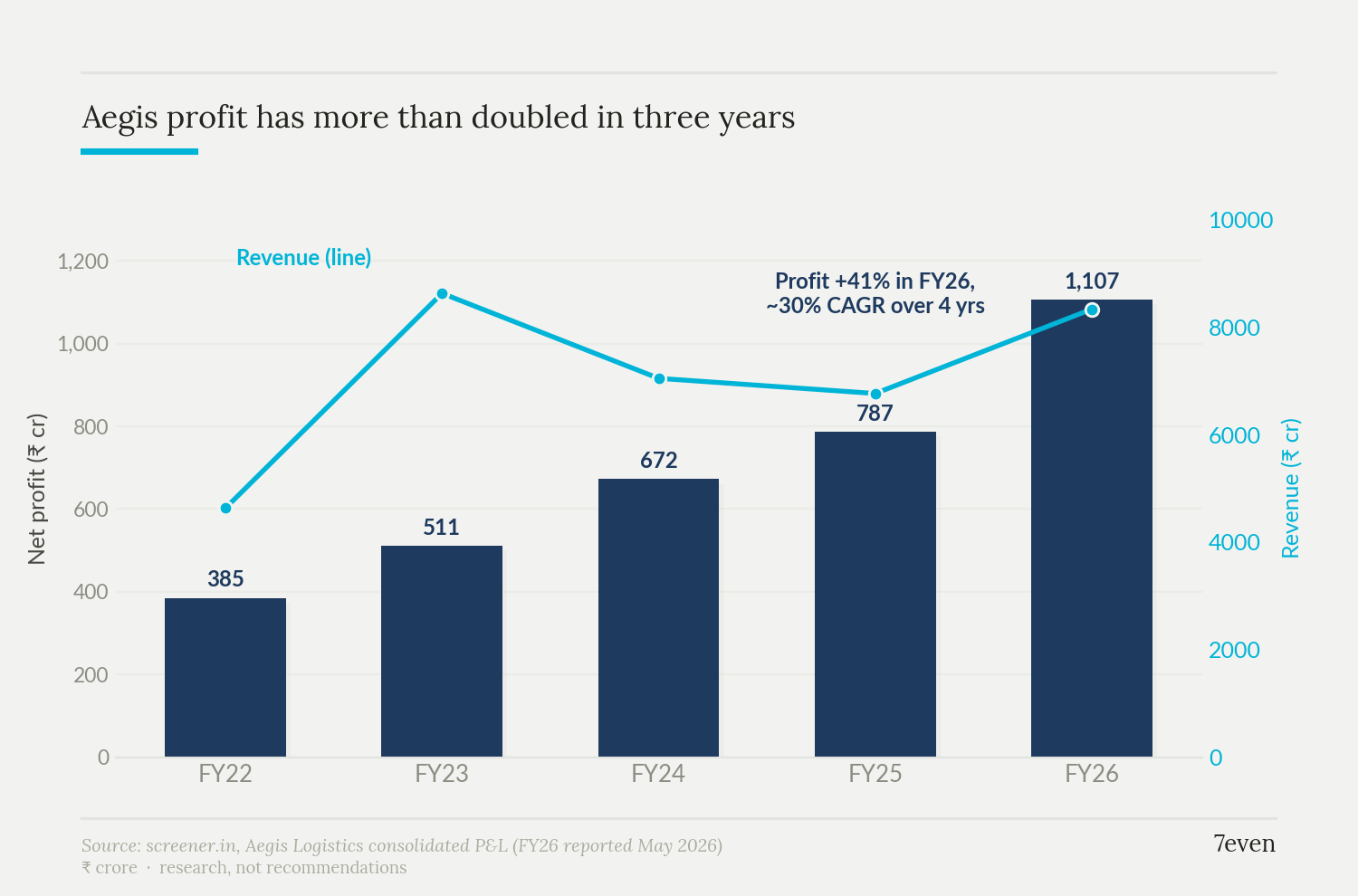
The operating numbers are strong. In FY26 Aegis grew revenue 23% to ₹8,333 crore, normalised EBITDA 36% to ₹1,599 crore, and consolidated net profit 41% to ₹1,107 crore. Over the four years to FY26, profit compounded at about 30% a year. This is not a sleepy utility; it is a fast-growing infrastructure-and-trading hybrid.
The capital has already noticed
This is where we part company with the version of the story that calls Aegis a stock “nobody is talking about.” As of this week, plenty are.
On 11 June 2026, the stock jumped about 16% in a single session, on volume roughly 15 times its two-week average. The trigger was a JP Morgan note: India’s LPG supply shortfall, near 50% in April, had eased to about 30% in May, and should normalise through Q2 FY27 as Aegis ramps volumes at Mangalore, Haldia and Pipavav. It has kept climbing, from about ₹659 in mid-May to ₹984 by 15 June, a fresh 52-week high after touching ₹1,005 intraday. Close to a 50% move in a month.
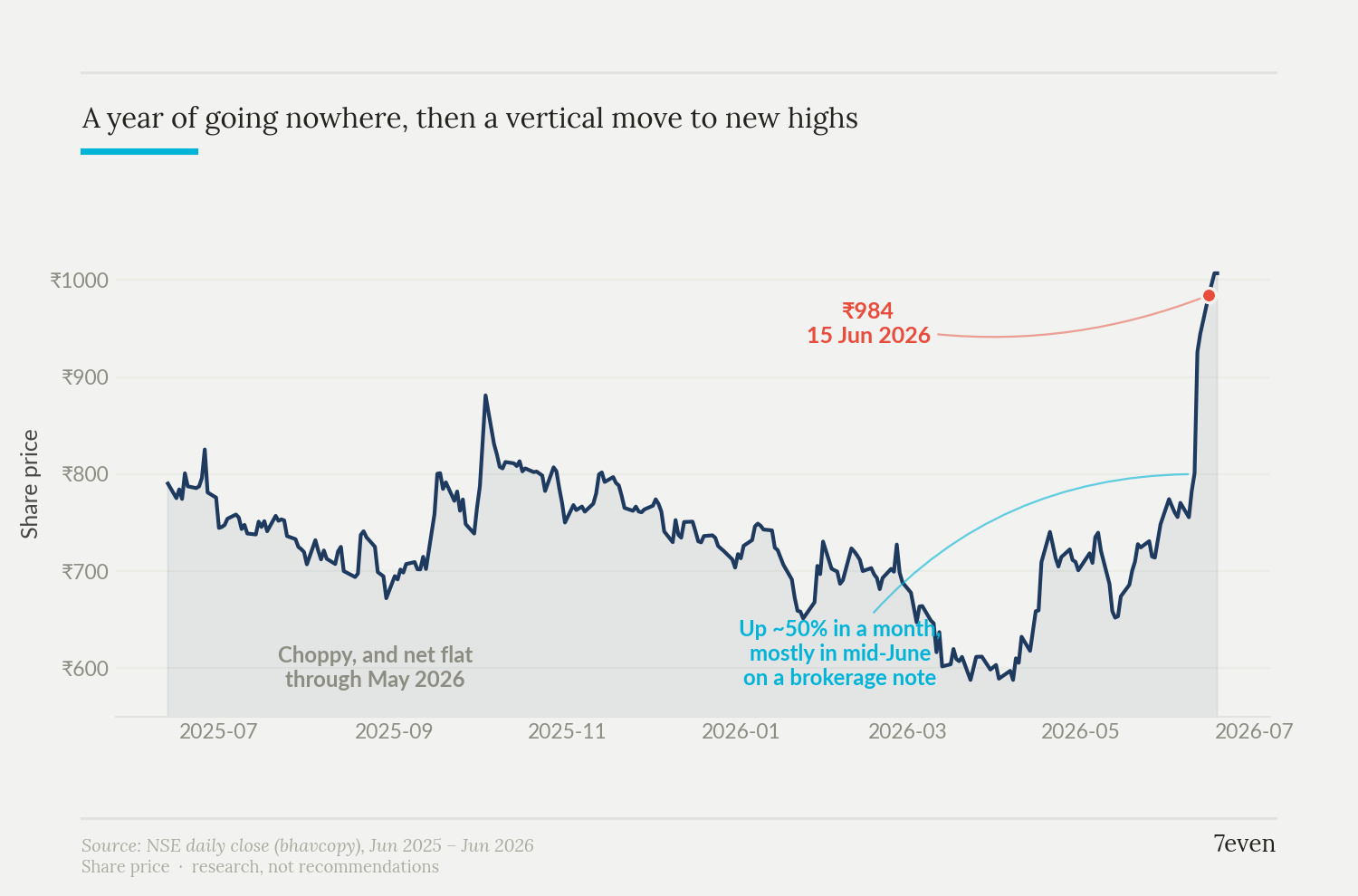
So this is not a hidden asset compounding while the market looks away. It is a well-covered stock that just broke out on a brokerage upgrade and a volume spike. The less-talked-about angle is not the company but the lens: the durable reason to care about Aegis is the import-infrastructure toll, not a one-quarter LPG swing. The market this week is trading that swing. The swing and the structural story justify very different prices.
The valuation tension nobody resolves
The bullish shorthand goes: “Yes, Aegis looks expensive on a P/E in the thirties, but terminal infrastructure should be valued on EV/EBITDA, like Petronet LNG, so the multiple is fine.” Run that comparison properly, and it argues the other way.
After the run, Aegis trades at roughly 38 to 39 times trailing earnings and about 5.7 times book, on a return on equity near 17%. Aegis Vopak Terminals, the listed toll booth itself, trades around 80 to 100 times earnings. Petronet LNG, the company actually invoked as the template, is India’s dominant LNG regasification terminal operator, an infrastructure near-monopoly, and it trades at about 10 times earnings and under 7 times EBITDA, on a return on equity around 20% and a dividend yield above 3%.
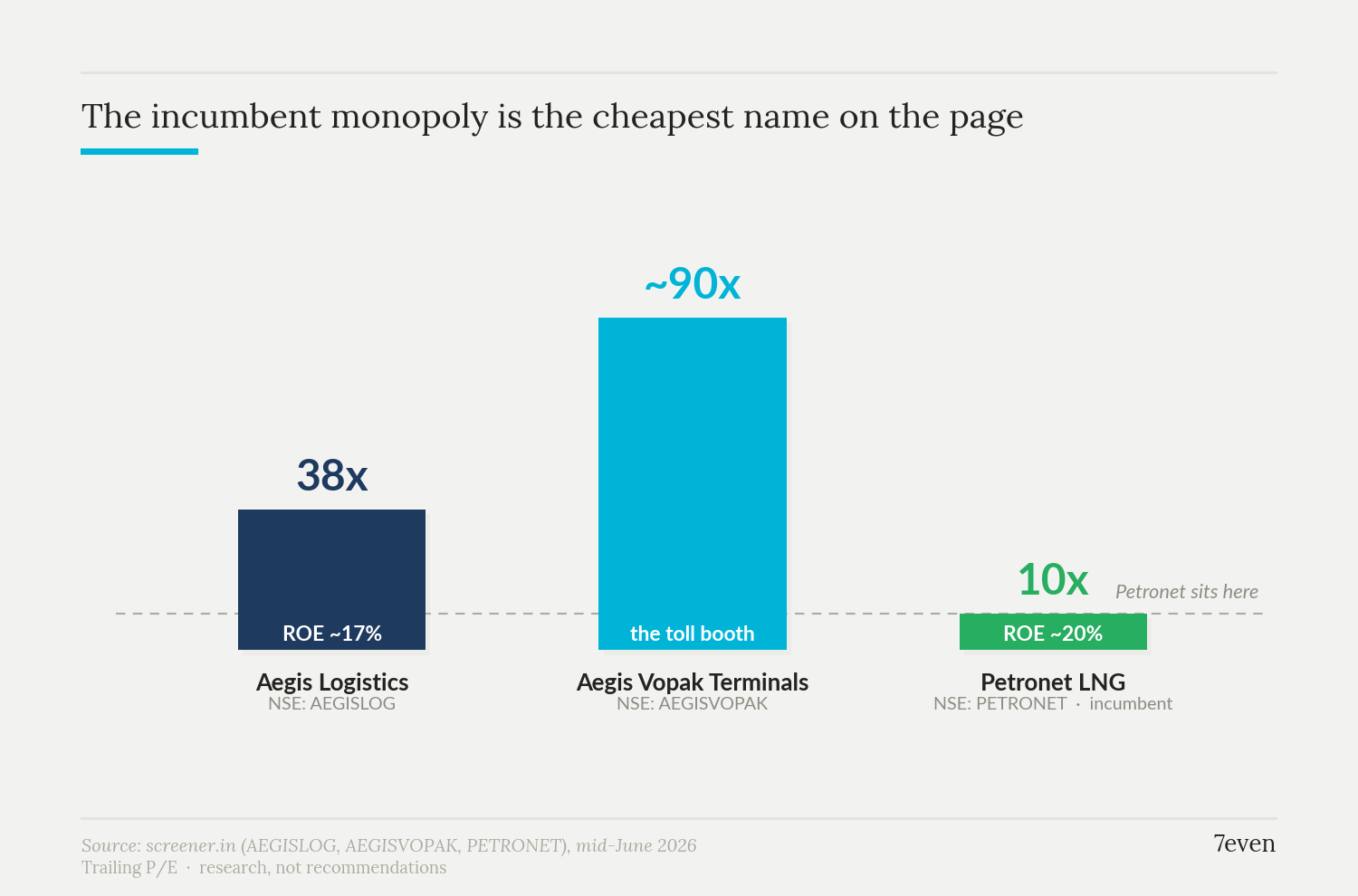
So the established terminal monopoly, with comparable returns, is one of the cheapest large energy names in the market, while Aegis and its JV carry some of the richest multiples in the sector. “Value it like infrastructure” does not make Aegis look cheap; it makes it look like the market has already paid in full, and then some, for a growth story yet to be delivered. The ramp the bulls point to, with Aegis Vopak’s LPG handling guided to rise from 1.8 million tonnes in FY25 toward 8.1 million by FY28, is not the reason the stock is cheap. It is the reason it is expensive: that growth is the multiple.
None of this means the premium is wrong. Scarce infrastructure with pricing power and a long runway can deserve a premium for years. It does mean the easy part of the trade, the re-rating from cheap to expensive, has largely already happened in plain sight.
Why the toll booth wins regardless
The structural case is the strongest part of the story. India’s energy import dependence is permanent, not cyclical: it imports the overwhelming majority of its crude and more than half its LPG, and demand keeps growing while domestic production does not. Where those imports come from is in constant flux. Russia went from about 2% of India’s crude in FY20 to roughly 35% by FY25, and was still around 31% in the first nine months of FY26. If the US deal pushes that mix toward American and Gulf barrels, that is simply another large rotation.
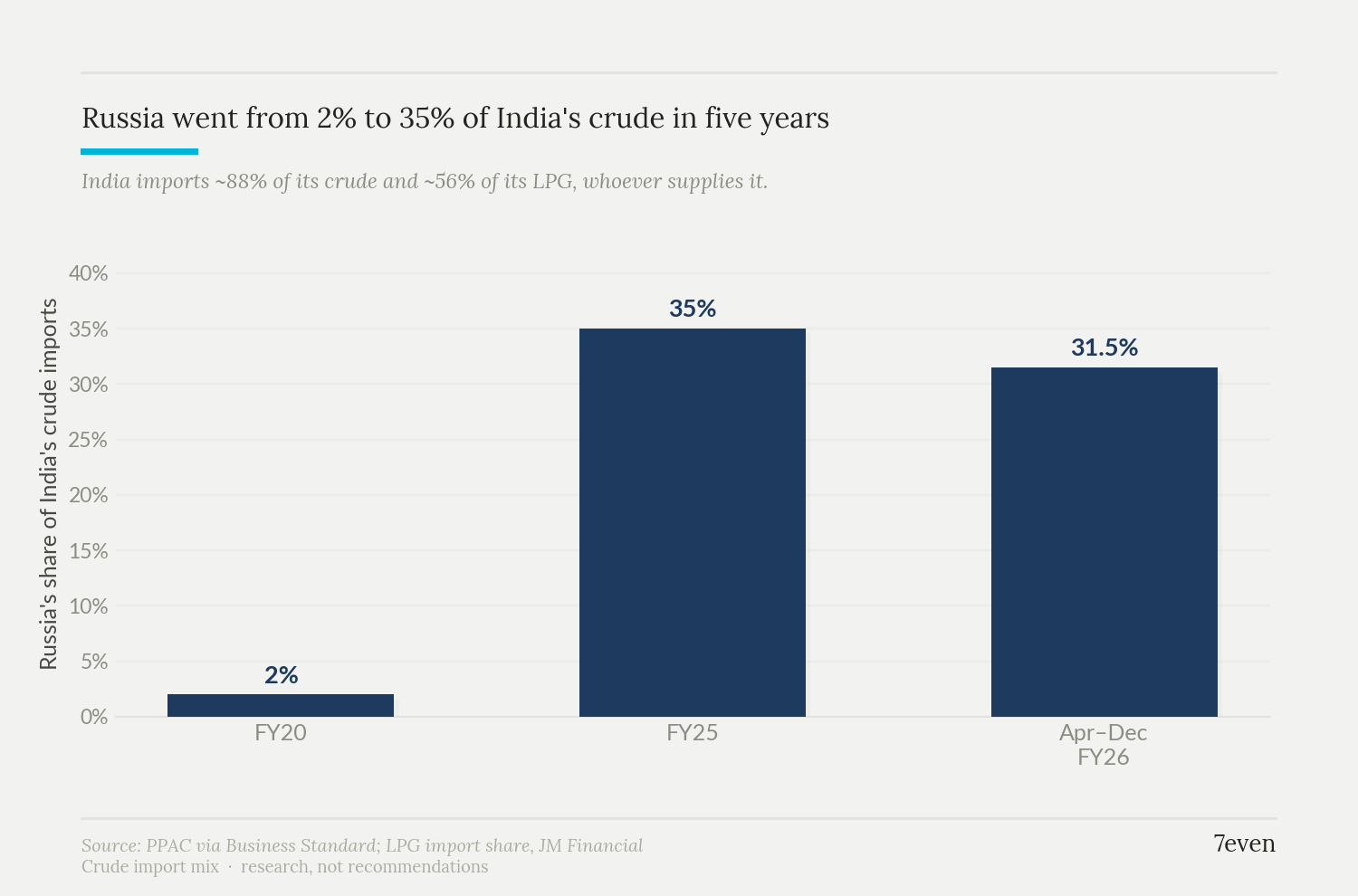
Each rotation is a story about which country sells the molecule. None of them changes the fact that it lands at an Indian port and moves through an Indian terminal. The terminal operator is, in effect, short the geopolitics and long the volume. That is a genuinely attractive position, and the part of the Aegis story least appreciated next to the export-winner headlines.
The catch is that Aegis is not a pure toll booth. A meaningful chunk of profit still comes from the volatile LPG trading margin, plus a large “other income” line and a balance sheet carrying around ₹4,150 crore of borrowings. It is part annuity, part trading business, wrapped in a holding company over a separately listed JV. That is messier and lower quality than Petronet’s clean regasification annuity, which is one more reason the steep premium is hard to defend on the infrastructure argument alone.
Where this view could be wrong
We are not making a call on the stock, and there are honest ways the cautious read here turns out to be too cautious.
The structural demand is real and durable, terminals are genuinely scarce and hard to permit, and Aegis Vopak’s storage share gives it real pricing power. If the throughput ramp toward 8 million tonnes lands on schedule, today’s rich multiple compresses on its own as earnings catch up, without the price having to fall. Infrastructure early in a long volume curve often looks expensive the entire way up, and selling it on the multiple alone has been a losing trade for a decade in names like this. And if the US trade deal genuinely accelerates the shift in India’s sourcing, volumes through independent terminals could step up faster than current guidance, with Aegis well placed to capture it.
There is a real counter on the bear side, too. The Russian-crude commitment at the centre of the trade-deal narrative is disputed: Washington has described it as a firm shift, while New Delhi has not formally confirmed it would stop buying Russian oil, and LNG and LPG are not the same molecule as crude, so the substitution story is looser than the headlines suggest. The import-infrastructure thesis does not actually need the Russia angle to work, which is a point in its favour, but anyone leaning on the trade deal as the catalyst is leaning on the shakiest part of the case.
So the honest summary is this. The theme is real: India’s energy pivot is, underneath the export noise, a story about import plumbing, and Aegis is the clearest listed way to own it. But it is not hidden; it just broke out to a new high on a brokerage note, and it is priced as if the growth is already in the bag, at multiples that dwarf the very incumbent the bulls compare it to. The question was never whether the toll booth is a good business. It is whether, after a near-50% month, you are buying the toll or the queue of people who just noticed it.
7even publishes research, not recommendations. Nothing here is investment advice. Always do your own work, and consult a SEBI-registered advisor before acting on anything you read.
Sources: Share price, NSE daily data (bhavcopy) cross-checked to June 2026 coverage; the 11 June surge, volume and JP Morgan note via Upstox and Business Standard. Financials, multiples, ROE and borrowings, screener.in: Aegis Logistics. FY26 results, Trade Brains. Aegis Vopak Terminals storage share, capacity, throughput guidance and listing, IPO disclosures via Chittorgarh and screener.in: AEGISVOPAK. Petronet LNG multiples and ROE, screener.in: Petronet LNG and Markets Mojo. India crude import dependence and Russia’s share of crude imports (PPAC data) via Council on Foreign Relations and PPAC oil-import coverage in Business Standard; LPG import dependence (56%) via JM Financial. India-US trade deal terms via CFR and CNBC.
Note on the numbers. The near-50% one-month move is measured from the 12 May 2026 close (about ₹659) to the 15 June 2026 close (₹984.3) on NSE data, with the bulk in the 10 to 12 June spike and a further push to a fresh 52-week high (₹1,005 intraday) on 15 June. P/E of about 38 to 39 and P/B of about 5.7 for Aegis are computed at the 15 June close against FY26 consolidated owner EPS of ₹25.59 and book value of ₹173 per share, so they read higher than the screener snapshot taken at ₹756 earlier in June. EV/EBITDA is north of 20x and rises with the price. Aegis Vopak (roughly 80 to 100x, which varies by source and day) and Petronet (about 10x) multiples are as of mid-June 2026 and move with the market. The Russian-crude share is PPAC data: about 35% in FY25 and about 31.5% for April to December 2025; monthly volumes have fallen further since (about 1.16 million barrels a day in February 2026 against a 2025 average near 1.71 million), which only underlines that the sourcing mix is in motion.