On 3 September the Digital Communications Commission reportedly cleared the price India will charge satellite broadband operators for spectrum: 5% of adjusted gross revenue (AGR), cut to 4% for rural and remote service, with the airwaves assigned for five years and an option of two more (MediaNama, Broadcast and CableSat). It still needs the Cabinet. Nothing is notified.
Much of the coverage has treated this as a number: TRAI said 4%, the Department of Telecommunications (DoT) wanted 5%, DoT won. We think the number is the least interesting part of the story. The bigger call was made before anyone argued about the rate, and the two companies with the most to lose from it signed up to sell the service it let in.
How the 5% was argued
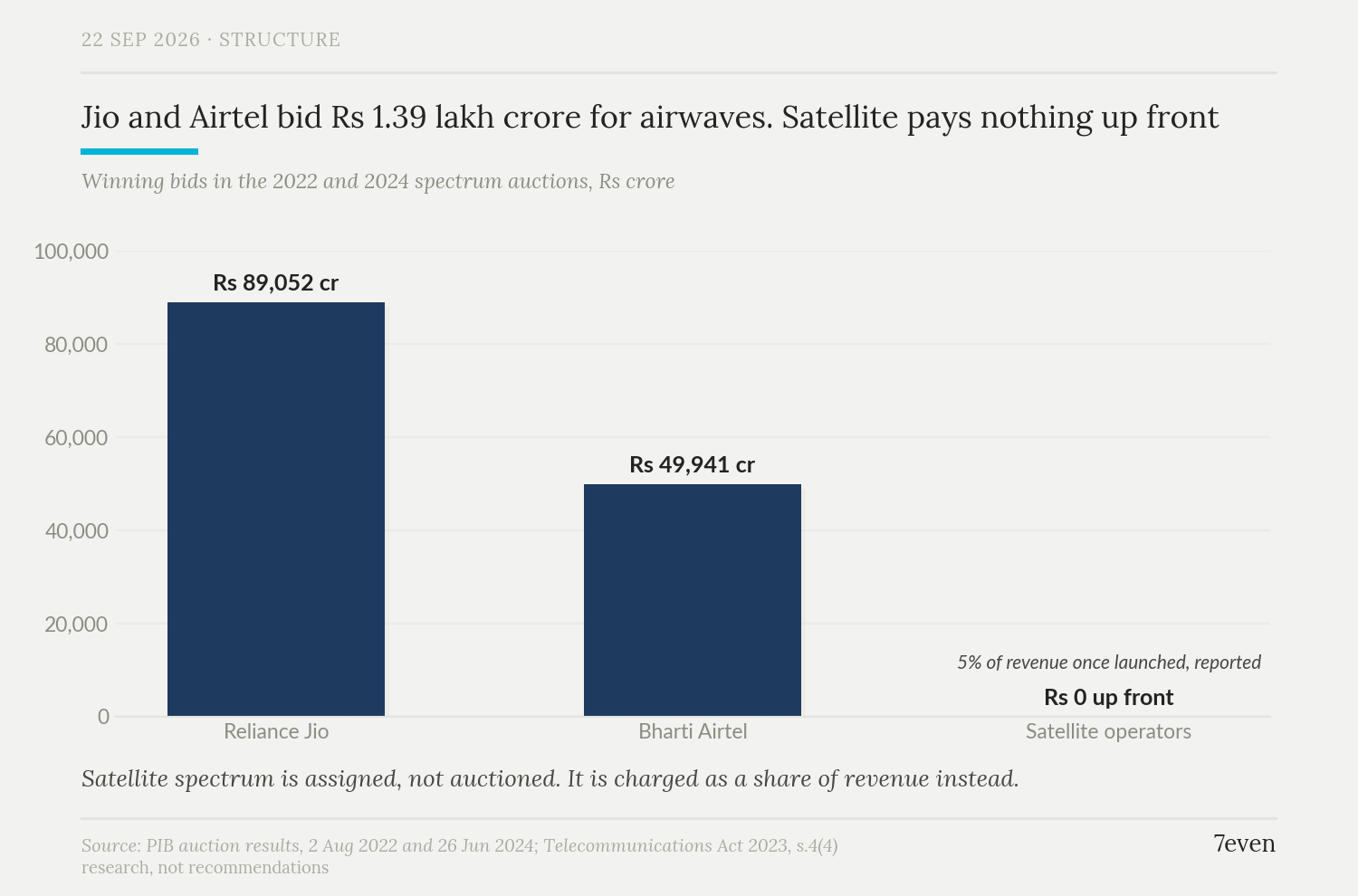
TRAI recommended its framework on 9 May 2025. Satellite broadband operators would pay 4% of AGR, plus ₹500 per subscriber a year in urban areas, with rural and remote users exempt, and a minimum of ₹3,500 per MHz a year (TRAI, restated in its 8 Dec 2025 response).
DoT sent it back on 12 November 2025. It proposed 5%, with a one-point discount if a share of customers came from border, hill and island areas, and no ₹500 charge. TRAI replied on 8 December that it “does not concur” and restated 4% plus ₹500 (same document).
The DCC has now reportedly sided with DoT.
If the reported decision stands, the rate goes up by a point and the one charge aimed at urban retail users comes off.
Why "5% versus zero" is the wrong scoreboard
The obvious comparison is with what Jio and Airtel pay for their own airwaves. Since the September 2021 telecom reforms, spectrum bought at auction carries no spectrum usage charge at all (PIB, 15 Sep 2021). On that one line, satellite looks more expensive.
But the telcos pay a different way: up front, at auction. In the 2022 auction Jio bid ₹88,078 crore and Airtel ₹43,084 crore (PIB, bid table). In 2024, Jio bid ₹973.62 crore and Airtel ₹6,856.76 crore (PIB). Across those two auctions that is ₹89,052 crore for Jio and ₹49,941 crore for Airtel, about ₹1.39 lakh crore together, payable in annual instalments.
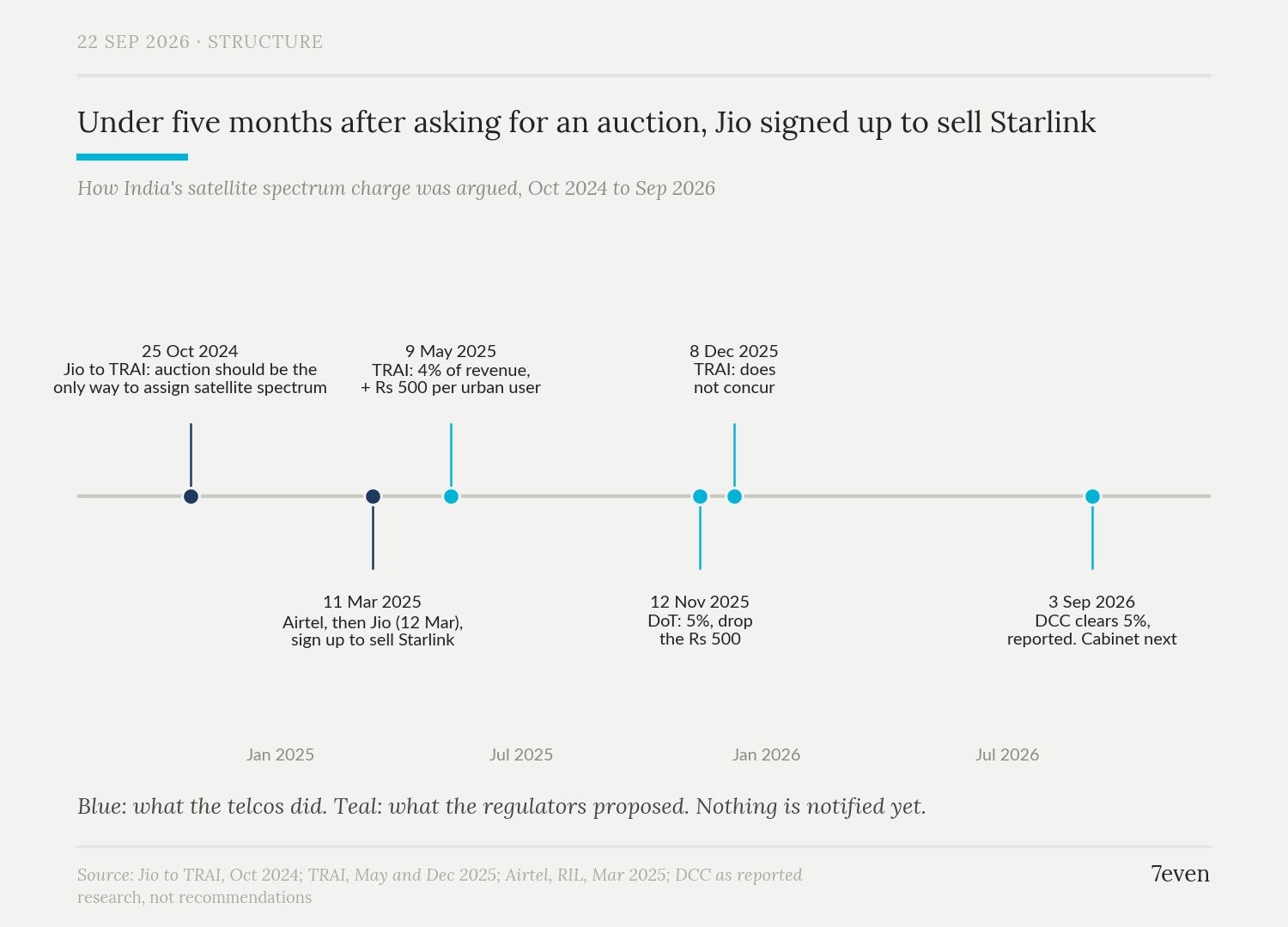
Satellite operators pay nothing up front. Under Section 4(4) of the Telecommunications Act 2023, their spectrum is assigned by administrative process, not auctioned (quoted by TRAI). They pay a share of revenue instead, above a minimum of ₹3,500 per MHz a year that the DCC reportedly kept. And the new satellite broadband entrants have not launched in India yet: as reported, they cannot start commercial service until spectrum is formally assigned and security clearance is granted.
Two more things make this less than like-for-like. Satellite bands such as Ku and Ka are assigned on a shared basis (TRAI Recommendation 4.3(b)), while mobile spectrum is bought block by block at auction, each operator winning its own MHz. And both sides pay the same 8% licence fee on top (DoT).
The telcos commit to their airwaves up front, at auction. Satellite operators will pay mostly as they earn.
The decision that mattered came first
The Telecommunications Act 2023 had already said how this spectrum would be handed out. Jio kept arguing anyway. Its 25 October 2024 submission to TRAI said an auction “should be mandated as the only mode” of assigning spectrum for satellite broadband and mobile satellite services (RJIL to TRAI).
Airtel asked for something narrower: pricing that addressed “level playing field” concerns where satellite operators sell “directly to customers in urban areas” (Airtel to TRAI). TRAI’s ₹500 urban charge was the closest thing to that in its framework. DoT dropped it, and the DCC reportedly agreed.
On paper, the incumbents lost both arguments: no auction and, as reported, no urban levy. The extra point on the rate is the one part that moved their way.
They had already joined the other side
On 11 March 2025, Airtel announced what it called “the first agreement to be signed in India” with SpaceX, to explore selling Starlink through its stores, subject to SpaceX getting its own authorisations. It said it would keep its “existing alliance with Eutelsat OneWeb” (Airtel). The next day Jio Platforms announced its own SpaceX deal, to stock Starlink equipment and handle installation, on the same condition (RIL). That was less than five months after Jio asked for an auction, and two months before TRAI published its recommendation. The incumbents were hedging while the argument was still live.
Both were in satellite before Starlink, too. Jio Platforms owns 51% of Jio Space Technology, its joint venture with SES (RIL, Feb 2022). The Bharti group, through Bharti Space rather than listed Bharti Airtel, holds 17.88% of Eutelsat, which combined with OneWeb in 2023 (Eutelsat, Nov 2025). OneWeb India, JIO Satellite Communications and Starlink all hold satellite service licences from DoT (PIB, Jan 2026).
So the two incumbents now sit in three places at once:
Payer. About ₹1.39 lakh crore bid for their own airwaves in 2022 and 2024.
Partner. Both signed up to sell Starlink.
Owner. Jio’s satellite JV with SES; the Bharti group’s stake in Eutelsat.
Whichever way the fee lands, both incumbents already have a seat on the satellite side of the table.
How this could be wrong
It is not final. The DCC figures are reported, not notified. The Cabinet can change them, and an urban charge could come back.
The deals may be thin. Both are subject to SpaceX’s approvals, neither discloses terms, and neither states any exclusivity; both telcos signed within a day of each other. Selling a dish is not the same as capturing the value of the subscription.
Satellite may stay small. If satellite broadband remains a niche product, the fee and the competitive threat both matter less than this debate suggests.
The comparison is structural, not a price per MHz. Different bands, shared assignment against blocks won at auction, different terms. We have not tried to put the two on one per-unit price, and we don’t think it can be done honestly with public data.
Bharti Space is not Bharti Airtel. The Eutelsat stake sits with the promoter group. Airtel’s own link to OneWeb, as it describes it, is an alliance.
What we’re watching
The Cabinet decision and the notified text: the rate, the discount condition, and whether any urban charge returns.
Formal spectrum assignment and security clearance, the gate for any commercial launch.
Whether Airtel or Reliance disclose terms, or revenue, from their Starlink deals in results.
7even publishes research, not recommendations. Nothing here is investment advice. Always do your own work, and consult a SEBI-registered advisor before acting on anything you read.