One company now carries more weight in the MSCI Emerging Markets Index than the whole of India.
That company is TSMC, the Taiwanese chipmaker. As of the MSCI factsheet dated 29 May 2026 (the latest published), it sits at 14.46% of the index, about 359 basis points ahead of India’s 10.87%. India is not one stock. It is every listed Indian name MSCI counts, put together. One foreign company outweighs all of them.
The milestone the headlines caught was a different one: for the first time in 26 years, no Indian company sits in the MSCI EM top 10. HDFC Bank and Reliance, the two largest Indian names in the index, sit just outside it. The top of the benchmark is now Taiwanese and Korean chipmakers.
Most coverage read this as a confidence story, another entry in the long-running “FIIs are selling India” file. We think that misreads what happened. This is not the market losing faith in India. It is the index quietly turning into something India was never built to win.
The number behind the headline
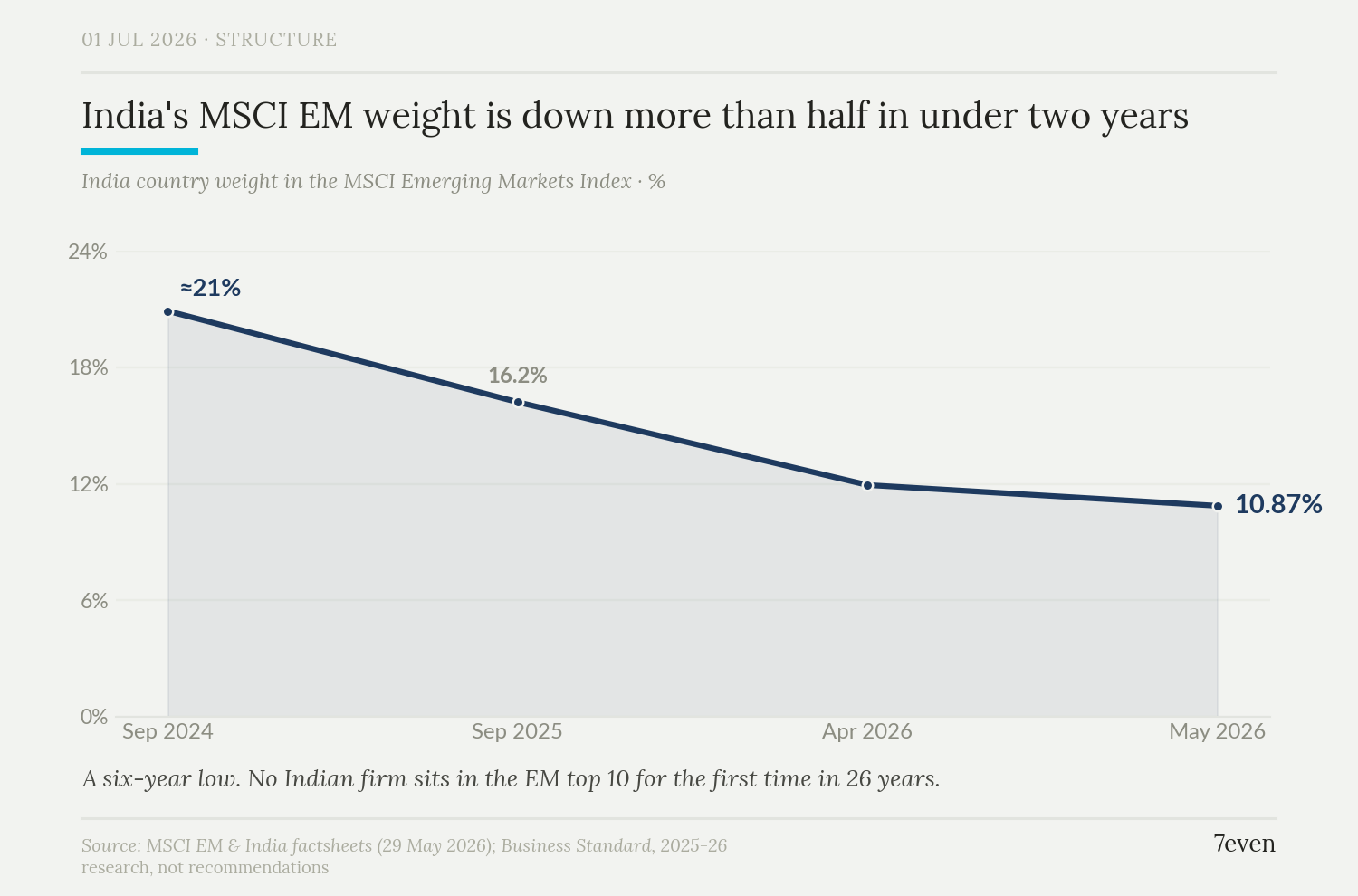
India’s weight in the MSCI EM index has fallen from a peak of nearly 21% in September 2024 to 10.87% now (29 May 2026), a six-year low. It passed through 16.2% around September 2025 and kept going. In under two years, India’s share of the most-tracked emerging-markets benchmark has been cut by more than half.
A weight cut of that size sounds like a verdict. It is worth being precise about what it actually measures, because the obvious interpretation is the wrong one.
India didn’t shrink. The rest ballooned.
A country’s index weight is its share of total market value, not a score the index assigns. So the weight can collapse for two very different reasons: your own market falls, or everyone else’s rises faster. Since September 2024, it has overwhelmingly been the second.
In dollar terms over the trailing year, the gap is stark. MSCI’s own net total-return series (to 29 May 2026, the latest published) shows MSCI India down about 11%, while MSCI Taiwan is up 122% and MSCI Korea has surged 193% (Korea’s factsheet is dated 30 Apr 2026, the most recent available). The broader MSCI EM index, boosted by exactly this rally, is up 54% over the same year. When the other side of the scale balloons like that, India’s slice shrinks automatically, even on a flat day for Indian stocks.
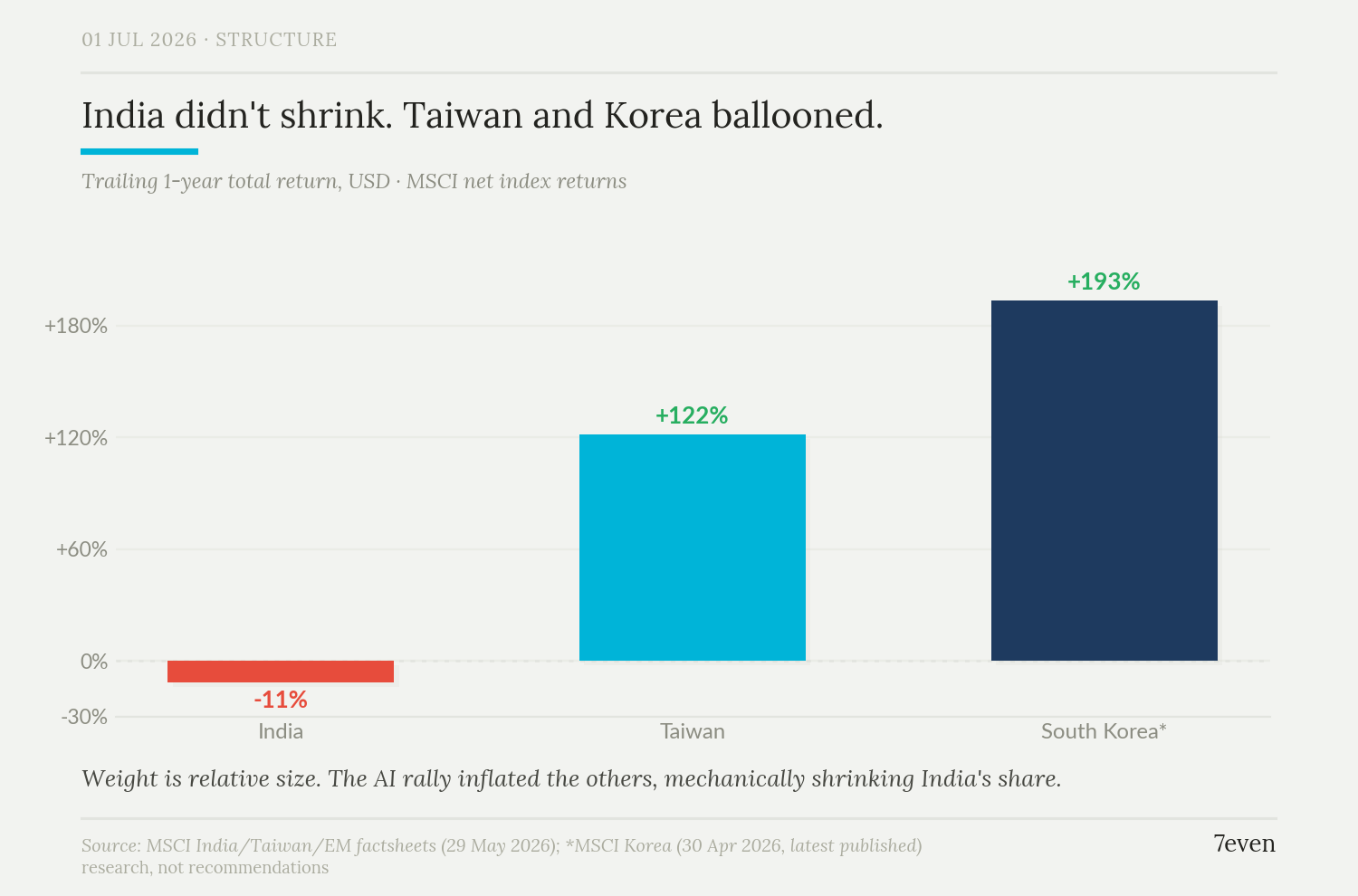
This is why “MSCI dumped India” is the wrong frame. The weight math did the work, and the weight math was driven by an AI-semiconductor rally happening somewhere else.
The part nobody wants to say: India owns the wrong sectors
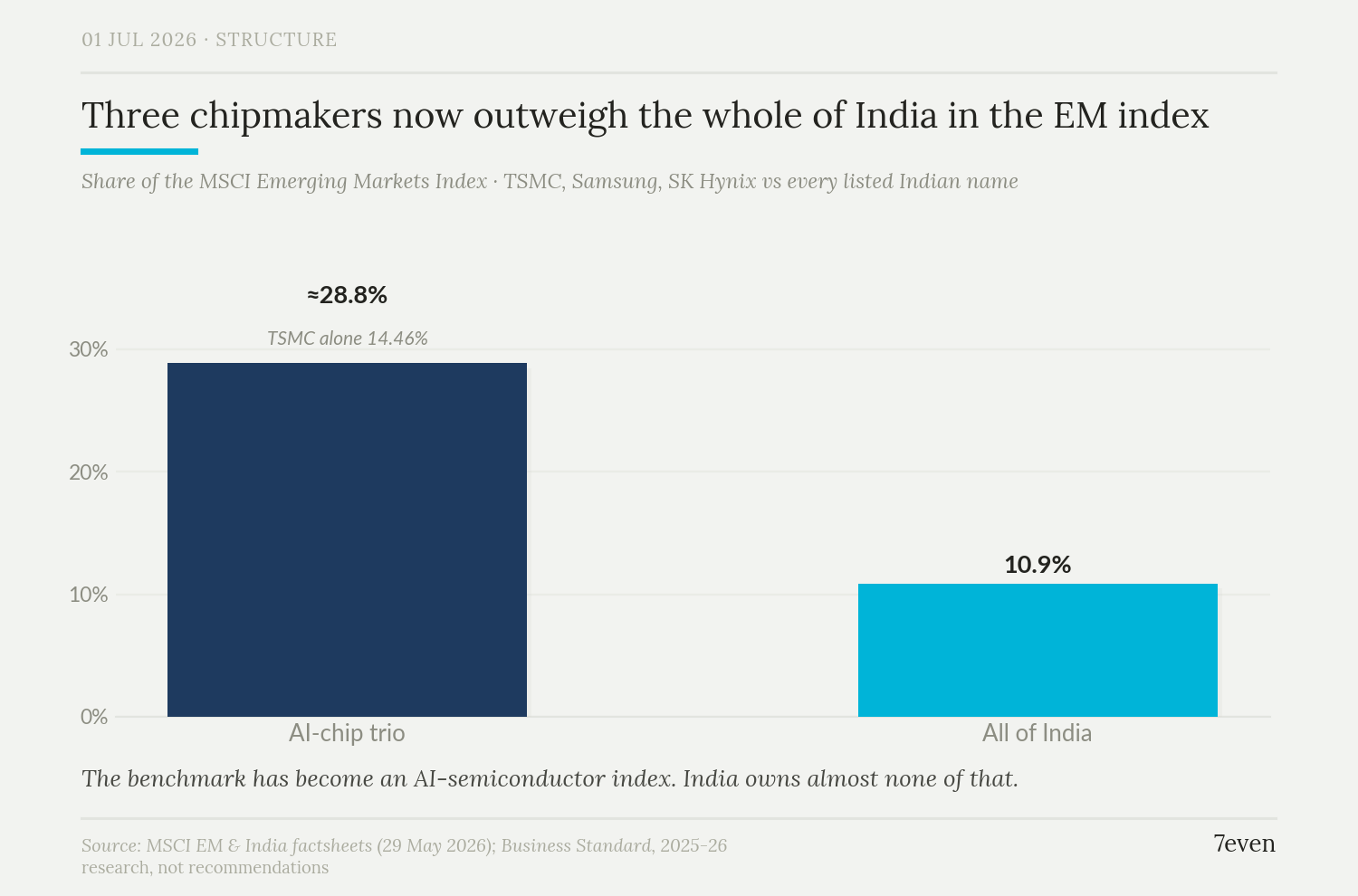
Here is the uncomfortable structural fact. Three chip stocks, TSMC, Samsung and SK Hynix, are now worth close to 28.8% of the entire EM index (14.46% + 7.78% + 6.60%). India, in full, is 10.87%. The benchmark has effectively become an AI-hardware index with a long tail attached.
India cannot ride that because India does not own it. Look at what the MSCI India index actually is, by the 29 May 2026 weights: Financials 28.5%, Consumer Discretionary 12.2%, Industrials 11.5%, Materials 9.2%, Energy 8.6%, Information Technology 7.5%, Consumer Staples 6.0%. It is a banks-and-consumption index. Even the “technology” in it is IT services, the Infosys-and-TCS kind that sells software and back-office work to other people’s companies. It is not the chips, the foundries, or the hardware that the AI capex cycle is actually paying for.
So when global capital decided this was the semiconductor decade, it did not so much sell India as walk past it. There was nothing in the Indian large-cap index for that trade to buy.
Why this drains a bid that has nothing to do with sentiment
A lower index weight is not just a talking point. It moves real money, mechanically.
A large pool of passive funds tracks the EM index, and they must hold each country at its index weight. So every time MSCI trims India’s weight at a rebalance, those funds are forced to sell Indian large-caps, regardless of what they think of India. At the May 2026 rebalance, a roughly 0.1 percentage-point cut to India’s weight translated to an estimated $800 million to $1 billion of passive outflow (Nuvama). That is the mechanical bid leaving on autopilot.
It is worth not overstating this. The passive flow at each rebalance is the small, mechanical layer. It sits on top of the much larger active and sentiment-driven selling: foreign investors pulled about ₹2.74 lakh crore (~$29.3bn) from Indian equities in the first half of 2026 alone, the largest H1 outflow since India opened to foreign portfolio investment in 1993, after ₹1.66 lakh crore for all of 2025. The point of separating them is that the passive layer keeps leaving on schedule even if sentiment turns, for as long as the weight keeps falling. It is the slow, structural drain underneath the noisy daily one.
What would actually change it
Two things could put India back at the table, and only one is in India’s hands.
The first is the cycle. If AI-chip demand cools and Taiwan and Korea de-rate, India’s relative weight recovers on its own, without India doing anything. That is the cleanest path and the least satisfying, because it is just the denominator deflating.
The second is India building something the index can actually buy. That is genuinely underway. The India Semiconductor Mission has drawn roughly ₹1.6 lakh crore (about $17 billion) in committed investment; around ten units are approved, and the flagship Tata-PSMC fab at Dholera, now roughly 50% built, is targeting first silicon by late 2026. But almost all of it is private or joint-venture capital, not listed companies at anything near index scale. A government chip programme does not show up as an MSCI weight. A large, listed, profitable Indian chip or AI-hardware champion would, and India does not have one yet. That seat is under construction, not occupiable.
How this could be wrong
A few ways. Weight is not returns. A smaller index share does not mean Indian stocks must fall; India can compound earnings perfectly well while owning a smaller slice of a benchmark inflated elsewhere. The drag is on the passive bid, not on the businesses.
The decline may also be more cyclical than structural. The AI trade is concentrated and richly priced; concentration that extreme has historically unwound, and if it does, this entire weight story partly reverses.
And India now has a domestic counterweight it lacked in past foreign-outflow cycles. Domestic institutions have been absorbing the foreign selling, and for the first time in over two decades, they own more of India Inc than foreigners do. The passive drag is real, but it is no longer landing on an undefended market.
The reframe
The daily “FIIs are selling” headline is the fast, loud, small force. The bigger and slower one is what kind of index India is being weighed inside. For a decade, India was rewarded for being the structural-growth story in emerging markets. Right now, the benchmark is rewarding something else entirely, and India simply makes none of it.
That is the question worth sitting with, ahead of the next rebalance and the next batch of chip earnings: not whether foreigners are selling this week, but whether India ends this decade owning anything the AI index actually wants to buy.
7even publishes research, not recommendations. Nothing here is investment advice. Always do your own work, and consult a SEBI-registered advisor before acting on anything you read.