When a company shelves its IPO in a weak market, the news gets filed under bad sentiment and forgotten. Deal pushed, mood poor, move on. That reflex misses the part that actually matters.
A shelved IPO is not a cancelled one. The company still wants the money. The approval is still live. The shares are still coming. All that has changed is the timing, and timing is the whole game when the buyer on the other side is a single, finite pool of domestic savings.
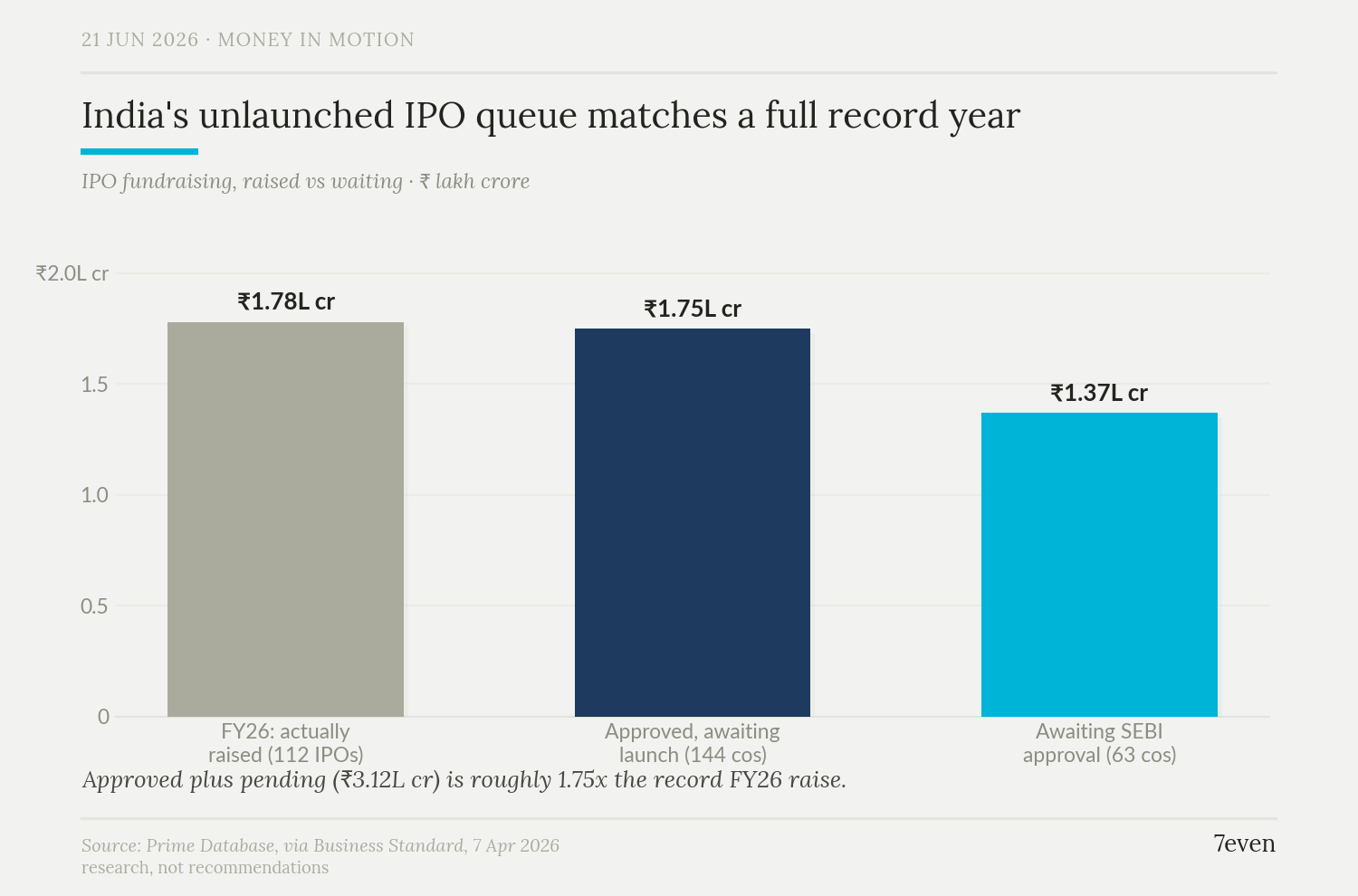
As of early April 2026, 144 companies holding live SEBI approval were waiting to raise about ₹1.75 lakh crore, with another 63 firms seeking ₹1.37 lakh crore still working through the approval pipeline. That is roughly ₹3.12 lakh crore of primary supply sitting on the runway, most of it deferred rather than dropped. The regulator then did something that tells you how it reads the situation: it froze the clock so none of it would expire.
This piece is about that wall, which has to absorb it, and why the answer changed while everyone was still watching the foreign-investor ticker.
What the regulator just did
On 7 April 2026, SEBI granted a one-time relaxation. Any IPO observation letter due to expire between then and 30 September 2026 had its validity extended to 30 September 2026.
The mechanics matter. An observation letter, SEBI’s clearance to launch, normally stays valid for twelve months (eighteen for confidential filings). After that, the company has to refile the draft papers and start the wait again. SEBI’s reason for the extension, in its own words, was that issuers faced difficulty accessing the capital market amid the war in West Asia, forcing many to defer, recalibrate or withdraw, and raising the risk of lapsed approvals and duplicated processes.
Read plainly, that is a regulator clearing congestion. The extension does not create demand or improve a single company’s prospects. It only stops approved supply from expiring, which keeps the queue intact for whenever a window opens. Business Standard reported the relief covered over two dozen firms directly; Prime Database data cited in the press put roughly 40 companies, together targeting about ₹43,500 crore, at risk of letting approvals lapse by September. The last time SEBI reached for relief like this was during the Covid-19 disruption. It is the move you make to manage a traffic jam, not a healthy flow.
The wall, measured
Put the queue next to what India actually raised, and the scale lands.
FY26 was a record year for the primary market: about ₹1.78 lakh crore was raised across 112 mainboard IPOs, beating the previous high of ₹1.62 lakh crore from 78 issues. That record absorbed a lot of capital. And yet the approved-but-unlaunched queue, at ₹1.75 lakh crore, is essentially a second record year, already cleared and just waiting to go. Add the ₹1.37 lakh crore still in approval, and the visible forward supply is about 1.75 times the record India just finished.
Some of this supply does leak away rather than launch, and that is fair to count. In FY26, 18 companies let approvals worth nearly ₹22,000 crore lapse, and 15 more withdrew draft papers covering about ₹9,200 crore. So roughly ₹31,000 crore of intended supply evaporated through the year. That is real, but it is a fraction of the queue, not the bulk of it. The base case is not that the wall vanishes. The base case is that most of it waits for a better tape and then prices.
That is the reframe in one line. Delayed supply is deferred, not destroyed. A weak primary market does not shrink the pipeline. It stores it, with pressure building behind the gate.
The demand side is where it bites
A supply wall only matters if you can name who is on the other side of it. Here, the buyer pool has narrowed to one.
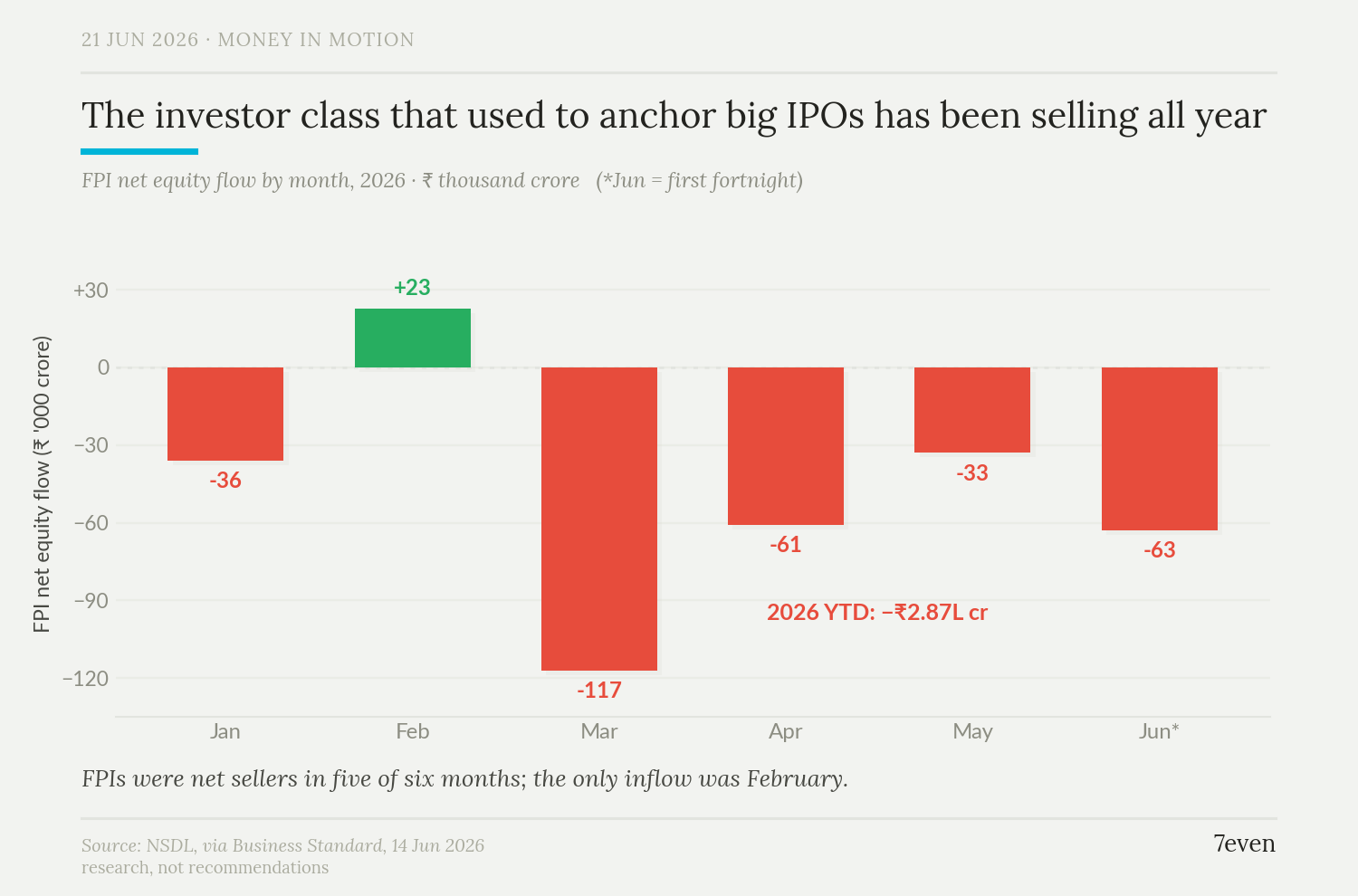
Foreign portfolio investors, the class that historically anchored large Indian issues, have been sellers for almost the whole year. By the middle of June, FPIs had pulled about ₹2.87 lakh crore out of Indian equities in 2026, already more than the ₹1.66 lakh crore they sold in all of 2025. They were net sellers in five of the first six months, with only a brief February pause, and March alone saw a record ₹1.17 lakh crore exit.
The drivers are familiar: a weak rupee, down about 6% in 2026 and near 95 to the dollar, plus rich Indian valuations against emerging-market peers and a global risk-off mood. The point for our purposes is narrower. The investor who used to take down a big chunk of every marquee book has been heading the other way.
That leaves the domestic institution as the marginal buyer, and it has carried the whole market. DIIs bought a record of roughly ₹4.3 lakh crore of equity in the first half of 2026, about ₹4,000 crore every trading day, fed by the monthly SIP that arrives regardless of the headlines. This is the bid that absorbed the foreign exodus without the index falling apart.
Now stack the two jobs that the single bid is being asked to do.
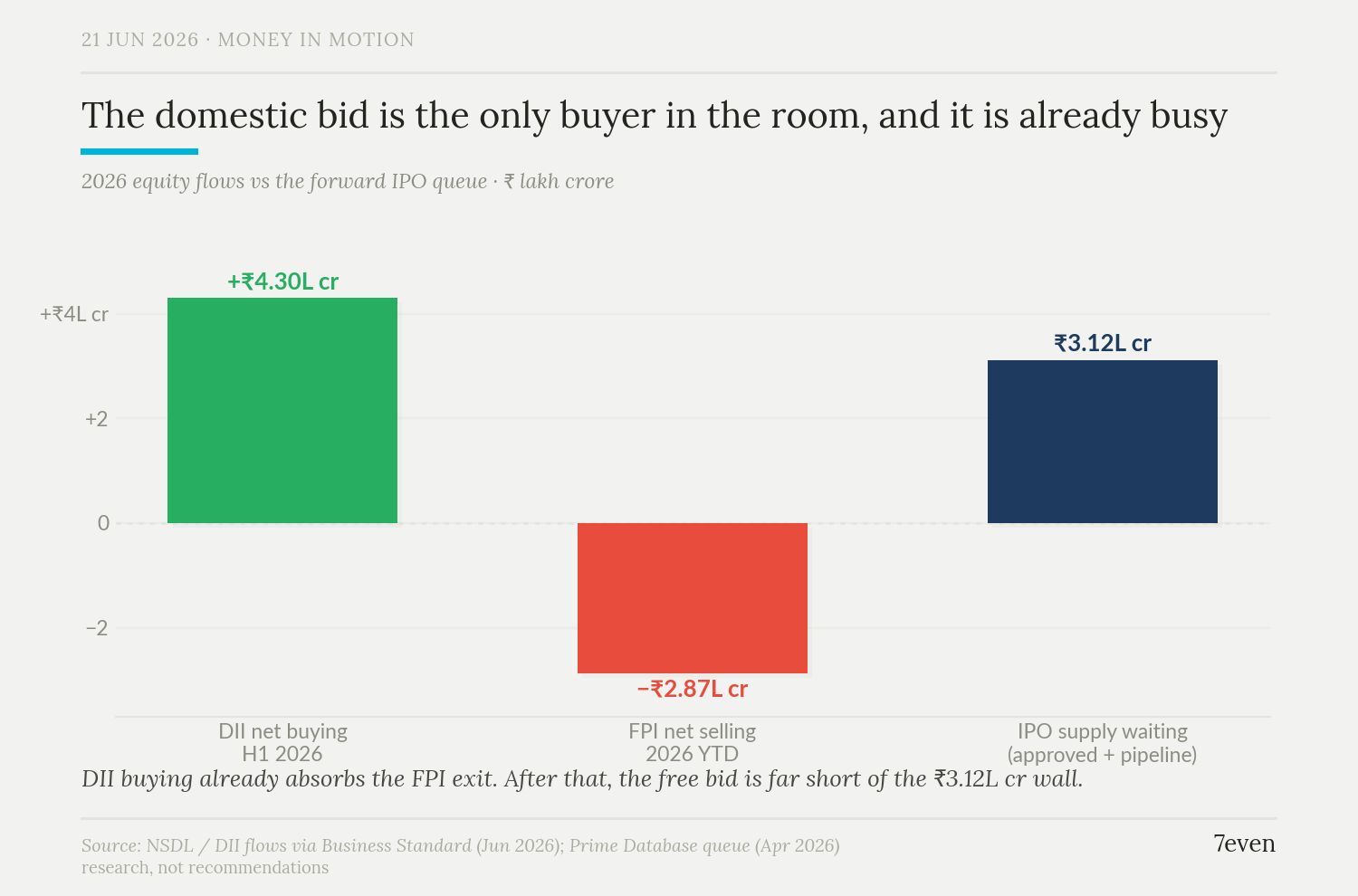
Of the ₹4.3 lakh crore the domestic side bought in the first half, a large slice simply offset the ₹2.87 lakh crore the foreigners sold. Net the two, and the free domestic bid is far smaller than the gross record suggests, on the order of ₹1.4 lakh crore over the half. Against that, the forward IPO supply is ₹3.12 lakh crore. The same rupee cannot both hold up the secondary market and fund a wall of new paper at full size. This is back-of-envelope, and the two windows are not identical, but the direction is hard to argue with. When the queue releases into a market where domestic money is already the only buyer, something has to give, either the pace of issuance or the level of the index that the issuance is priced against.
The marquee names tell the same story twice
On 17 June, the National Stock Exchange filed its draft papers. The issue is a pure offer for sale, up to 14.89 crore shares, around 6% of the exchange, with an estimated size of nearly ₹30,000 crore against an unlisted valuation of roughly ₹5 lakh crore. In an OFS, the company raises nothing. Existing holders sell, and the cash flows to them. Two days later, on 19 June, Jio Platforms filed for what could be India’s largest-ever IPO: a pure fresh issue of up to 27 crore shares, no OFS, estimated between ₹30,000 crore and ₹52,000 crore, with about ₹27,500 crore earmarked to repay debt.
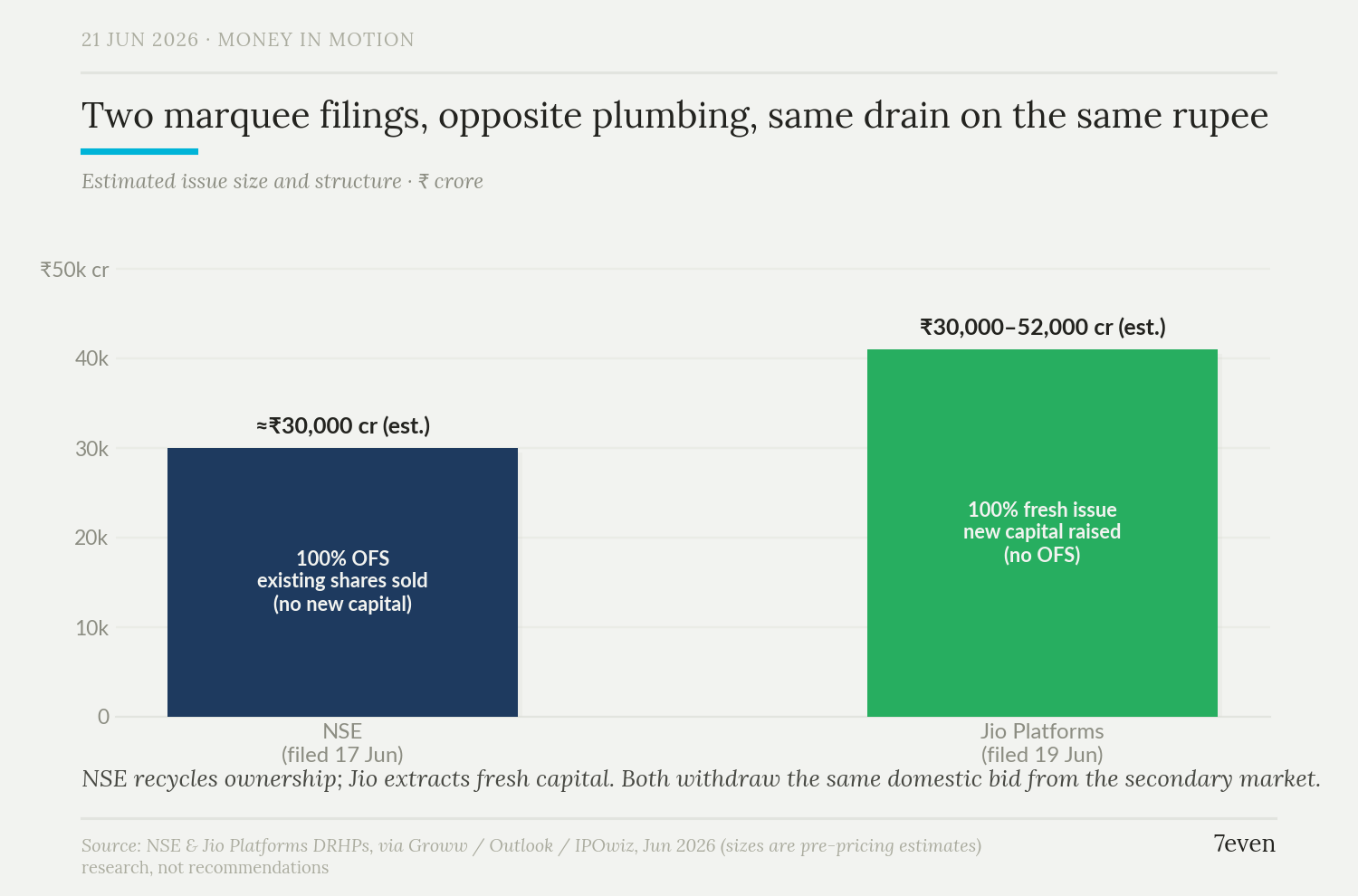
These are mirror images. NSE recycles ownership and adds float without creating any new capital. Jio extracts fresh capital and creates no new float for selling holders. The accounting could not be more different. The effect on the buyer pool is identical: both withdraw the same domestic rupee from the secondary market and park it in primary paper. Whether the cash ends up with a selling shareholder or inside the company, it is no longer available to bid up the index.
One more detail keeps the framing honest. Both names were filed only this month, so neither sits inside the ₹1.75 lakh crore approved queue measured in April. They are joining the back of the line. The pipeline is still lengthening with giants even as the front of it cannot clear, which is the opposite of a queue that is quietly draining.
The number worth tracking
If this thesis is right, it should be measurable, not just narratable. The gauge is an absorption ratio.
Track monthly primary mobilisation, the total pulled out of the market through IPOs, follow-ons, QIPs and offers for sale, against net DII equity inflow for the same month. When that ratio is low, domestic money comfortably funds both new issuance and the secondary market. When it climbs, the bid is being asked to do two jobs at once, and that is the setup where a cluster of issues can cap a rally instead of riding one. Watch it turn in the months when the queue starts converting approvals into launches. That is the test, and it will either support this read or break it.
Where this view could be wrong
This is a supply-and-flows argument, and there are real ways it disappoints.
The most important thing is that the wall may never reach full height. Much of the queue can lapse or downsize rather than flood the tape. FY26 already showed roughly ₹31,000 crore leaking away through lapses and withdrawals, and a stretch of weak listings would push more issuers to shrink or shelve. Supply that prices in a soft market also tend to be cheap, which is a problem for the seller, not the index.
Second, the trigger that finally opens the window usually solves the demand problem at the same time. Primary markets reopen in force when sentiment and flows turn, and a genuine recovery typically arrives with fresh foreign inflows, not just domestic money. If FPIs swing from ₹2.87 lakh crore of selling to buying, the extra demand absorbs the supply, and the wall releases into a market that can take it. The squeeze only binds if the queue releases while foreigners are still absent, and that combination is not guaranteed.
Third, more supply is not purely a drag. An OFS like NSE’s adds free float and broadens ownership, which is exactly what large index-inclusion candidates need, and deeper float can pull in passive and foreign demand that was previously capped out. A fresh issue like Jio’s is capital formation, and using ₹27,500 crore of it to retire debt is balance-sheet repair, not value leakage. Healthy markets are supposed to convert savings into primary capital. A full pipeline is, in the long run, a feature.
And the domestic bid has been deeper and more durable than the bears expected all year. It absorbed a record foreign exit without breaking. Betting on a supply wall to overwhelm it is, in part, a bet that the monthly SIP finally meets a load it cannot carry, and that bid has not blinked yet.
So hold this as a lens, not a forecast. The claim is not that the market must fall when the queue releases. The claim is narrower and more useful: deferred IPO supply is real, it is large, and it competes for the one bid that is currently holding the whole market up. When foreign money is selling, and domestic money is the only buyer, the timing of that release stops being a footnote about sentiment and becomes a flow event worth watching. The IPO that got delayed did not disappear. It got in line.
7even publishes research, not recommendations. Nothing here is investment advice. Always do your own work, and consult a SEBI-registered advisor before acting on anything you read.
Sources: SEBI one-time relaxation extending IPO observation-letter validity to 30 September 2026, the twelve-month validity rule, the West Asia rationale, the “over two dozen firms” reach, the Covid-era precedent, the approved-but-unlaunched queue (144 companies, ₹1.75 lakh crore), the approval pipeline (63 companies, ₹1.37 lakh crore), the FY26 record raise (₹1.78 lakh crore via 112 mainboard IPOs vs the prior ₹1.62 lakh crore via 78), and FY26 lapses and withdrawals (18 companies, ~₹22,000 crore lapsed; 15 companies, ₹9,200 crore withdrawn), all via Prime Database as reported by Business Standard (7 April 2026); the ~40 companies / ₹43,500 crore at-risk estimate via Prime Database as reported by Free Press Journal and Angel One. FPI 2026 net outflow (₹2.87 lakh crore year-to-date through mid-June, surpassing ₹1.66 lakh crore for all of 2025), the monthly breakdown (Jan −₹35,962 cr; Feb +₹22,615 cr; Mar −₹1.17 lakh cr; Apr −₹60,847 cr; May −₹32,963 cr; June first fortnight −₹62,853 cr), net-seller in five of six months, and the rupee near 95 / down ~6% in 2026, NSDL data via Business Standard (14 June 2026). DII record buying (~₹4.3 lakh crore in H1 2026, ~₹4,000 crore a day) via Business Standard (10 June 2026). NSE DRHP (filed 17 June 2026, pure OFS of up to 14.89 crore shares, ~6% of equity, est. ~₹30,000 crore, unlisted valuation ~₹5 lakh crore, no proceeds to NSE) via Groww, Outlook India and IPOJI. Jio Platforms DRHP (filed 19 June 2026, pure fresh issue of up to 27 crore shares, no OFS, est. ₹30,000–52,000 crore, ~₹27,500 crore for debt repayment, Elara valuation ₹12–13 lakh crore) via Outlook Business, Sahi and Multibagg. Broader pipeline context (Equirus: 236 mainboard proposals as of May 2026; Axis Capital: 124 approved-but-unlaunched / 64 awaiting clearance at end-March 2026) via Multibagg.
Note on the numbers. The queue figures (144 / ₹1.75 lakh crore approved, 63 / ₹1.37 lakh crore in pipeline) are Prime Database snapshots dated early April 2026; they predate the NSE and Jio filings and shift as companies launch, lapse or file. Independent trackers count the approved-but-unlaunched cohort slightly differently (Axis Capital put it at 124 at end-March), so treat ₹1.75 lakh crore as the order of magnitude, not a fixed total. FPI and DII flow figures are NSDL and exchange data over slightly different windows (FPI is calendar-2026-to-mid-June, DII is the first half), so the netted “free bid” figure of about ₹1.4 lakh crore is an illustration of the squeeze, not a precise account, since DII money funds far more than the FPI offset alone. NSE and Jio issue sizes are pre-pricing estimates from press coverage of the DRHPs and will firm up only at the price-band stage.