There is a date on the calendar that will reshape how every large Indian bank reports profits, and most people who own bank stocks have never heard of it.
On 1 April 2027, Indian banks will switch from provisioning for loan losses after they happen to provisioning for losses before they happen. The Reserve Bank of India refers to it as the Expected Credit Loss framework. CRISIL estimates the one-time hit to bank capital could run as high as 120 basis points of CET1, net of the buffers banks already hold. Fitch is gentler, but still sees the sector’s core capital ratio dipping around 30 basis points in the first year.
This is not a crisis. No bank is about to fail because of it. That is exactly why it gets no attention. There is no press release, no earnings miss, no single dramatic day. It is an accounting rule that compounds quietly across four years. And the quieter a thing is, the more likely retail investors are to be holding the stock without knowing the rule exists.
So here is the question worth asking before April 2027 arrives, not after: if the way banks count losses is about to change, do today’s bank valuations reflect it?
What is actually changing
Right now, Indian banks follow an “incurred loss” model. In plain terms, a bank waits for a loan to show real, objective signs of trouble, usually once it crosses 90 days without payment and turns into a non-performing asset, before it sets aside money against it. The provision arrives after the damage is visible. It is backwards-looking by design.
The Expected Credit Loss model flips the timing. From the day a loan is made, the bank has to estimate what it could lose over the life of that loan and reserve for it in advance, using forward-looking models that fold in macroeconomic forecasts. The RBI’s own language is that banks must “recognise credit stress at an early stage, well before it crystallises into non-performing status.”
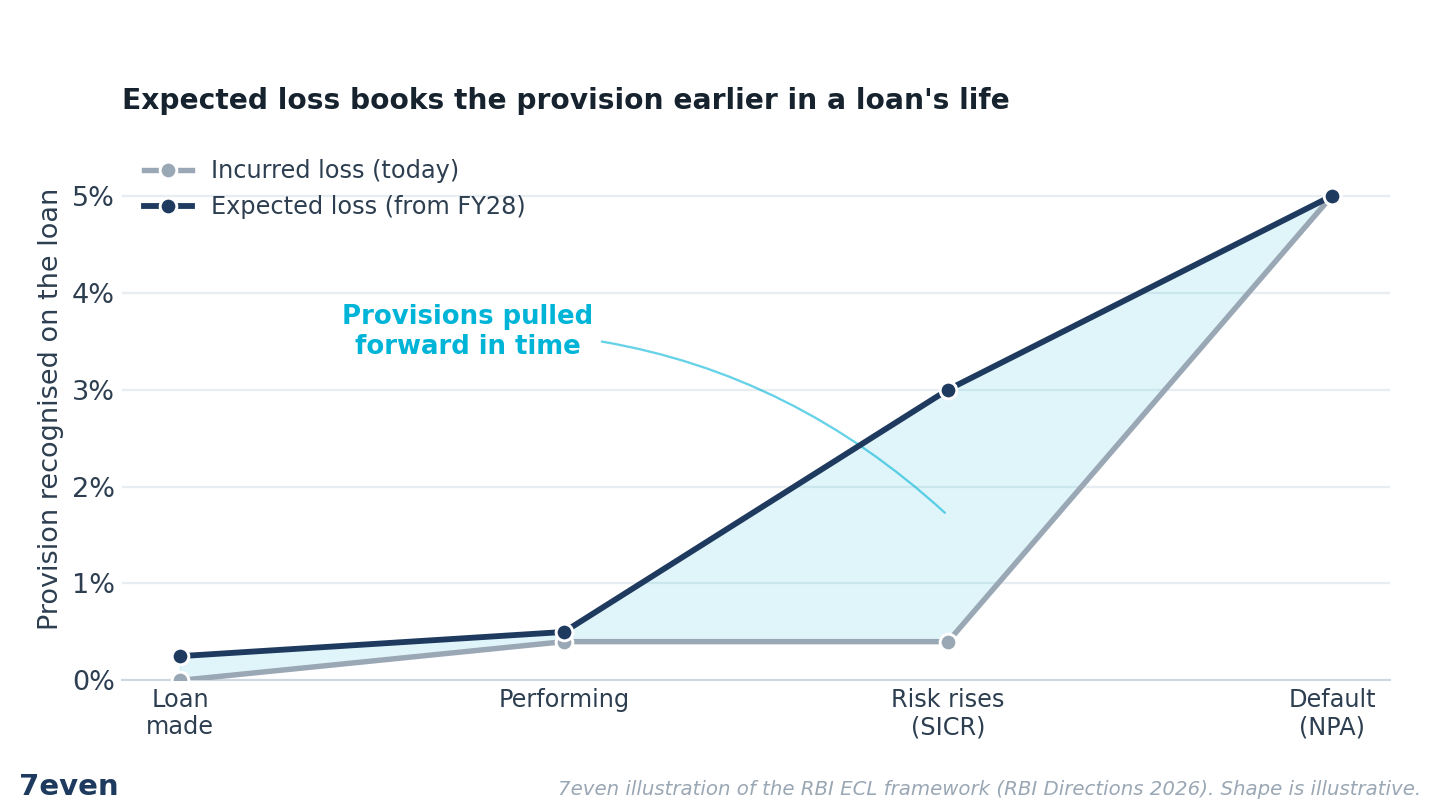
The shift pulls provisions forward in time. The same loan, the same eventual loss, but the money is set aside earlier. Pulling a cost forward does not change the lifetime economics of a loan. It does change reported profit in the years the change takes effect, because provisions that would have been spread out, or never recognised at all on loans that quietly recovered, now land sooner. This is the heart of why it matters for earnings.
The framework also aligns India with IFRS 9, the global standard most large economies already use. It is not an experiment. It is India catching up.
The mechanism: three stages, and one sharp jump
Under ECL, every loan gets sorted into one of three stages, and the provisioning rises with each step.
Stage 1 is a healthy, performing loan with no meaningful deterioration. The bank reserves for 12 months of expected loss, with a minimum floor of 0.25%. For most good loans, this is close to what banks already do.
Stage 2 is where it bites. A loan moves to Stage 2 when it has seen a “significant increase in credit risk” since it was made, but has not yet defaulted. Think of a borrower who is still paying but whose financial signals are flashing amber. For these loans, the bank must now reserve for losses over the entire remaining life of the loan, not just 12 months. The minimum provisioning on many of these exposures rises to as much as 5%, against the 0.25% to 0.40% that standard assets attract today.
Stage 3 is a credit-impaired loan, roughly what the system already classifies as an NPA. It carries the heaviest provisioning, much as it does now.
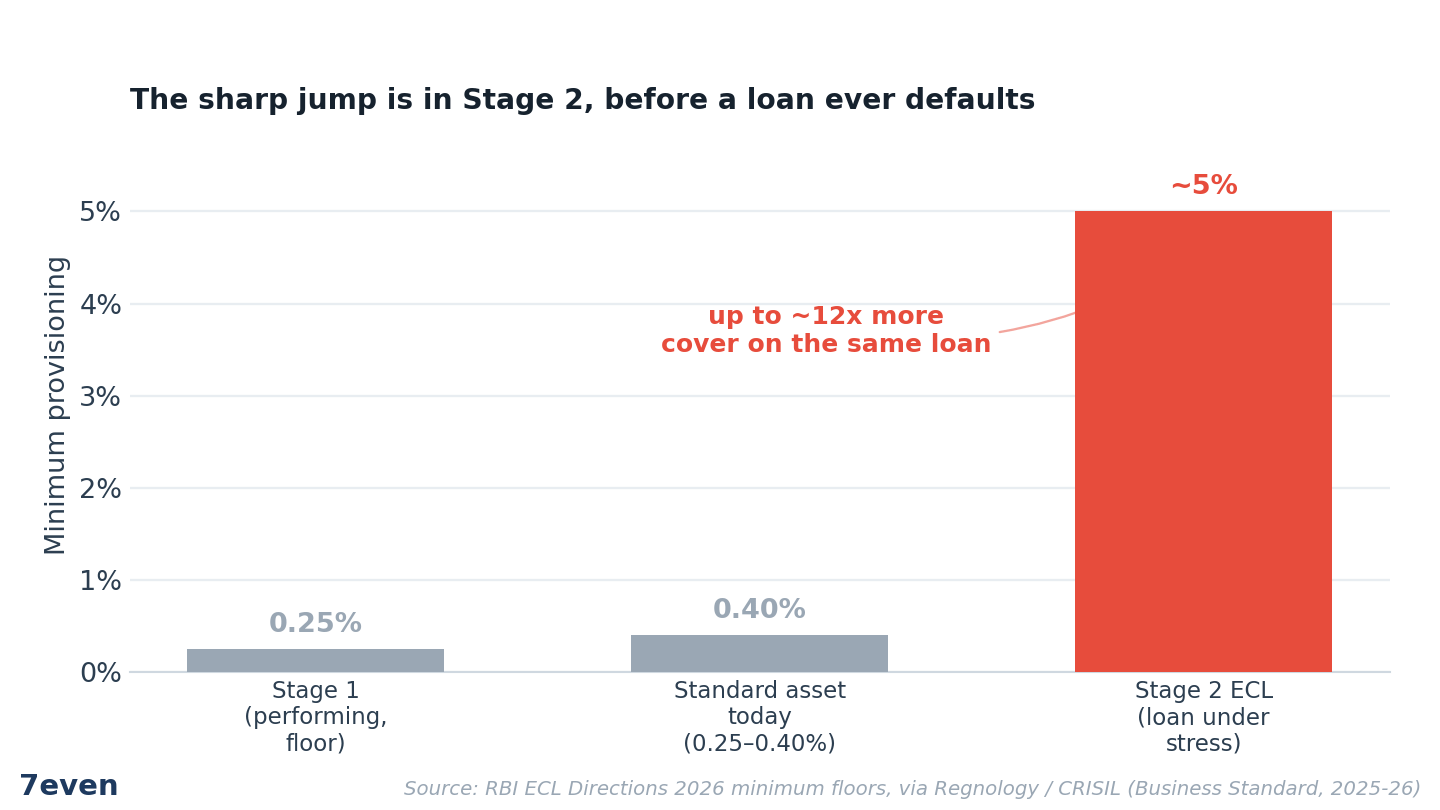
The jump from under 0.40% to as much as 5% on Stage 2 loans is the single largest mechanical change in the framework. The reassuring part, and CRISIL makes this point, is that Stage 2 assets are only about 2% to 2.2% of system loans today. The framework hits a small slice hard rather than the whole book a little. To stop banks from gaming the models, the RBI has also layered in product-wise minimum floors, regulatory backstops that limit how low a bank can estimate its own losses.
How big is the hit
This is where the honest answer is “it depends, and the estimates vary widely.”
CRISIL puts the gross impact at up to 170 basis points of CET1, the core capital ratio, falling to up to 120 basis points net once existing provisioning buffers are counted. Fitch is far more relaxed: it sees the average sector CET1 ratio dipping about 30 basis points in the first year of adoption, rising to roughly 80 basis points cumulatively if banks use the full transition period.
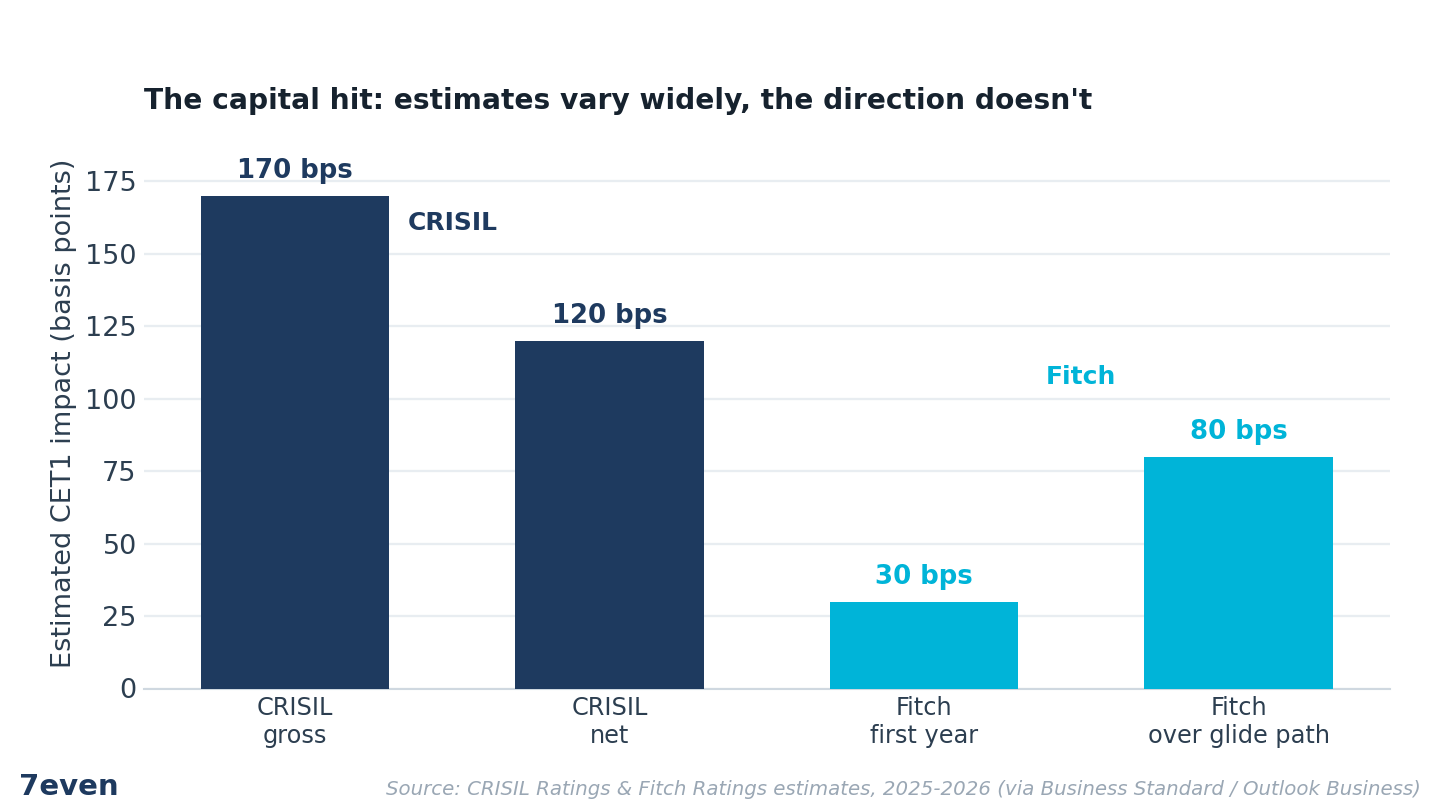
The range is wide because the two are measuring different things, gross versus net, one-time versus phased. The direction, though, is the same in every estimate. Provisions rise, core capital takes a one-time knock, and return on equity compresses modestly for a stretch of years rather than collapsing in one quarter.
The RBI has deliberately softened the landing. Banks can spread the impact across four financial years, from FY28 through FY31, the transition window that closes on 31 March 2031. A hit absorbed over four years is a headwind, not a shock. But a headwind that blows for four straight years is still worth knowing about when you are paying for a bank’s future earnings today.
The part that creates winners and losers
The ECL hit is not spread evenly. It falls hardest where the expected loss on a loan is structurally highest, which means unsecured lending.
According to analysts at Grant Thornton Bharat, the incremental provisioning will be heaviest for microfinance and unsecured retail loans, personal loans, credit cards, and various digital and co-lending products. It is moderate for SME loans, loans against property, and vehicle finance. It is lowest for housing and gold loans, where there is hard collateral behind the borrower.
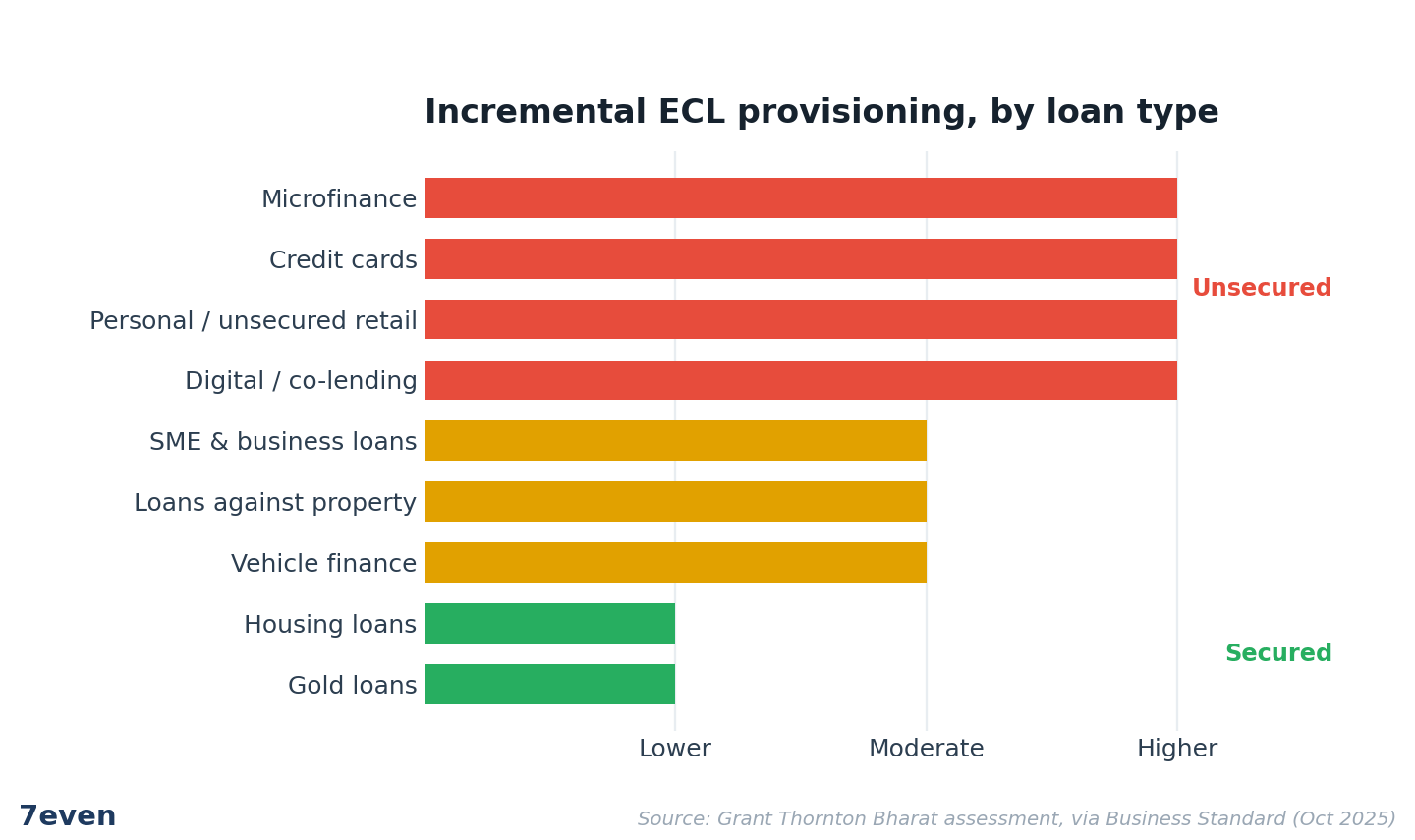
That single fact does most of the work in separating the sector. A bank built on home loans and gold loans will barely notice the transition. A bank that leaned into personal loans, credit cards and microfinance to chase growth in the last few years will feel it more. When the draft norms landed, brokerages were quick to name the latter group, flagging mid-sized lenders with heavier unsecured and microfinance books as the ones likely to set aside the most. Large private banks, sitting on strong buffers and years of improving asset quality, were generally seen as facing a minimal one-time impact.
This is the differentiation that the current sector narrative mostly ignores. “Banks” are not one trade here. The rule rewards the boring, secured lenders and quietly taxes the ones that grew fastest on unsecured credit.
Why does it land at an awkward moment?
The ECL transition does not arrive in a vacuum. It lands on top of a margin squeeze the sector is already living through.
The RBI cut its policy repo rate by 125 basis points between February 2025 and December 2025, from 6.50% to 5.25%, before pausing at 5.25% through the first half of 2026. Floating-rate loans reprice downward almost immediately when the repo falls. Deposits reprice with a lag. The gap compresses net interest margins, the core spread a bank earns, in the meantime.
So the sector is absorbing tighter margins now and a multi-year provisioning step-up from FY28. Two independent pressures, on the same set of companies, over an overlapping window. Neither one is fatal. Both are real. And a market that is paying up for bank earnings should be modelling both, not just the rate-cut headline that “lower rates are good for loan growth.”
So why doesn’t retail see it coming
Because the rule has no trigger.
Stock stories that retail investors absorb tend to have a moment: a results day, a profit warning, a regulatory fine, a CEO exit. ECL has none of that. It is a slow, scheduled, well-flagged accounting change that the RBI put out in draft in October 2025 and finalised in April 2026, close to a year before it takes effect. It will show up not as a headline but as a line in quarterly provisions that runs a little higher than it used to, for years, until someone asks why return on equity is no longer what the back-of-envelope said it should be.
The interesting question, and we hold it as a question rather than a call, is whether the price-to-book multiples on Indian banks today already reflect a few years of gently compressing returns. Large private banks trade at meaningful premiums to book value. Some of that premium is earned by genuinely high, stable returns on equity. If those returns are set to soften modestly through FY31, the multiple is leaning on an earnings path that the rulebook has already started to bend.
Where this view could be wrong
We are deliberately not in the catastrophe camp here, and there are good reasons the whole thing could prove a non-event.
The most important thing is that the people who run these banks already know all of this. Fitch’s assessment in May 2026 was that Indian banks are “well positioned” for the transition, partly because current provisioning is running higher than the new rules will require. SBI’s chairman has spoken about being prepared. When the regulator gives a sector a year of notice and a four-year glide path, and the sector is sitting on its strongest balance sheets in over a decade, the odds of a disorderly hit are low.
The numbers support that calm. Stage 2 assets, where the provisioning jump is sharpest, are only about 2% of system loans. The largest private banks may see almost no one-time capital impact at all. And ECL, over time, is genuinely good for the system: earlier recognition of stress is more honest accounting, and it should make reported book values more trustworthy, not less.
There is also a real chance the market has partly priced this already. Analysts have written about ECL since the discussion paper in 2023. It is not a secret to institutions. The gap, if there is one, is between what professional desks have modelled and what the retail shareholder reading a “bank stocks are cheap” post has absorbed. Those are not the same audience, and they are not paying the same informed price.
So the thesis is narrow, and we will keep it that way. ECL will not break the banks. It will, on the central estimates, shave returns on equity for several years, hit unsecured-heavy lenders harder than secured ones, and do it without ever producing the kind of dramatic moment that makes retail investors pay attention. The risk is not a crash. The risk is paying a premium multiple for a return profile that a known, dated, four-year rule change is quietly working to lower, while watching the wrong things for the signal.
The date is on the calendar. The math is in the rulebook. None of it needs a forecast to see.
7even publishes research, not recommendations. Nothing here is investment advice. Always do your own work, and consult a SEBI-registered advisor before acting on anything you read.
Sources: Framework, stages, scope, effective date and transition window, RBI (Scheduled Commercial Banks - Asset Classification, Provisioning and Income Recognition) Directions, 2026, issued 27 April 2026, via RBI and summarised by KPMG India and Regnology. The effective date and glide path are also via Business Standard. CET1 impact, CRISIL up to 170 bps gross / 120 bps net (and the ~2% Stage 2 share) via Outlook Business and KNN India; Fitch ~30 bps first-year / ~80 bps over the glide path and “well positioned” via Business Standard. Stage detail and minimum floors via Regnology. Impact by loan type (Grant Thornton Bharat) and unsecured-heavy lenders via Business Standard. Repo-rate path Feb 2025 to 5.25% and the June 2026 pause via Business Standard and Upstox.
Note on the numbers. The capital-impact figures are agency estimates, not RBI guidance, and they measure different things: CRISIL’s 170/120 bps is a gross-versus-net one-time view, Fitch’s 30/80 bps is a first-year-versus-cumulative view. They are presented as a range, not a single forecast. Stage 2 minimum provisioning is cited as “up to ~5%” because the exact floor varies by product under the RBI’s prudential backstops. Bank valuation multiples move daily and should be refreshed at publish time.