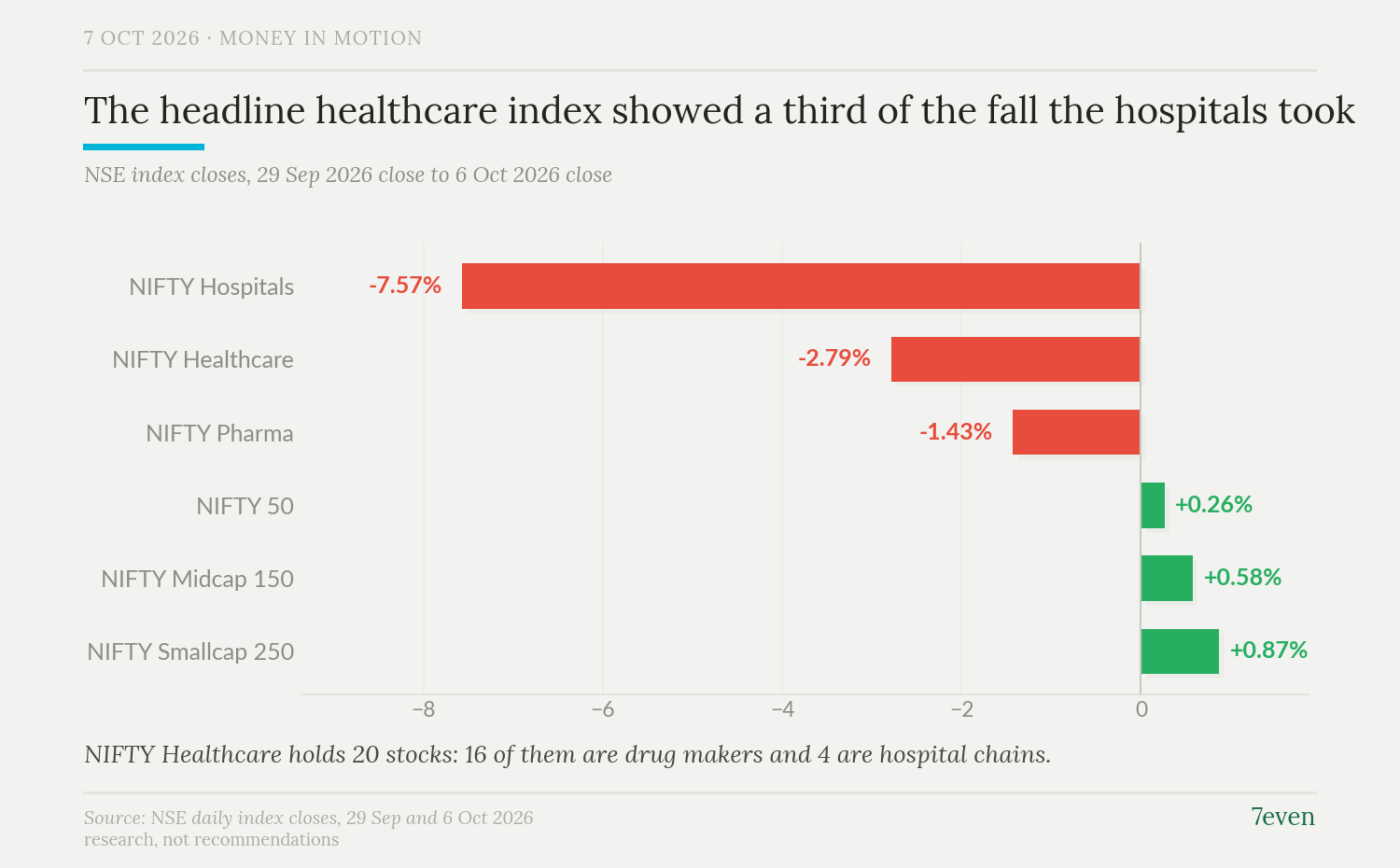
Over the four trading sessions from the 29 September close to the 6 October close, the Indian market barely moved. The NIFTY 50, NSE's index of 50 large and heavily traded listed companies, rose 0.26%. Mid-sized companies, measured by the NIFTY Midcap 150, rose 0.58%, and smaller ones, the NIFTY Smallcap 250, rose 0.87%.
One group went the other way, hard. NIFTY Hospitals, NSE's index of listed hospital chains, fell 7.57%. Of the 145 of NSE's equity indices that have a close in its own file for both days, none fell as far. The next worst, down 2.79%, was the healthcare index, which holds four hospital chains.
This was not one company dragging a group down with it. The index holds eleven stocks. Its ten largest, 98.97% of its weight at 30 September, all fell, in a range from 3.28% to 9.94%. Weight each one's fall by how much of the index it is, and the largest single contributor accounts for 22.6% of the move. That is a group being repriced, not one company's bad week wearing a sector's clothes.
What set it off
On 29 September a Supreme Court bench of Justices Vikram Nath and Sandeep Mehta, hearing petitions on medicine pricing, asked why the price of an essential medicine could not be capped at 16% above the price a retailer pays for it, and pointed to a cancer drug selling at about ₹27,000 against a price to the retailer of about ₹2,700 (Business Standard, 29 September 2026). The same report records the bench raising the pricing of medicines dispensed through corporate hospitals: that patients are often required to buy their medicines from the hospital's own pharmacy, and that the higher cost ends up reimbursed from public money when the treatment is covered by a government scheme such as Ayushman Bharat. Those were remarks from the bench, not an order.
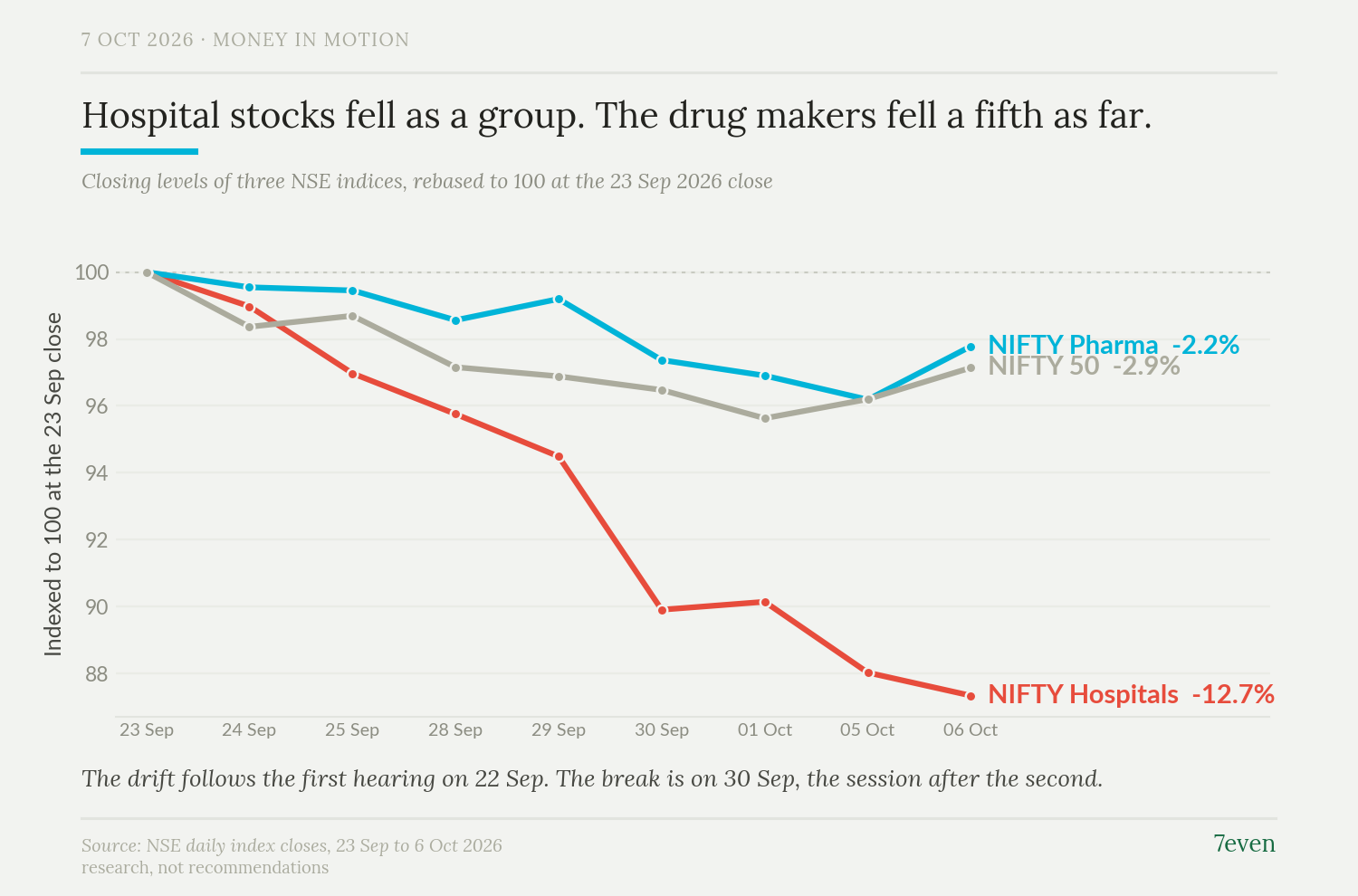
The next session, 30 September, the hospital index fell 4.85%. That is its steepest single session since NSE launched the index on 15 June 2026, which is less than four months of history.
The part the headline number hid
Anyone checking healthcare that week saw NIFTY Healthcare down 2.79% and had little reason to look further.
That index is not a hospital index. NSE's own constituent lists show it holds twenty stocks. Sixteen of them are also in NIFTY Pharma. The other four are hospital chains. Two of those four are 13.55% of the index's weight and carried 1.14 of its 2.79 point fall, so 13.55% of the index did at least 41% of the damage. The other two hospital names fell too, and their weights are not published in the factsheet's top ten, so 41% is a floor rather than the total. Six of the ten largest hospital stocks are not in NIFTY Healthcare at all.
The sector most people check showed about a third of the move that happened in hospitals.
Who got repriced, and how hard
NIFTY Pharma, the drug manufacturers, fell 1.43% over the same four sessions, and three of its ten largest holdings rose. On 6 October the NIFTY 50 rose 0.98% and NIFTY Pharma rose 1.66%, while the hospital index fell a further 0.78%.
The makers were not left alone, though. In the 30 September session, the one right after the hearing, NIFTY Pharma fell 1.84% against the NIFTY 50's 0.42%. The drug makers were marked down too. The hospital index fell 4.85% the same day.
Read what was actually asked in court and that split is less odd than it looks. A cap measured over the price the retailer pays is a limit on what the seller adds on top, not on what the maker charges the trade. The 16% is not a number the bench invented either. It is the notional retailer margin already written into the Drugs (Prices Control) Order, 2013 when the government works out the ceiling price of a scheduled essential medicine, and scheduled medicines are about 10% of the medicines on the market (Business Standard, 29 September 2026). India has pulled that lever before. In August 2021 the drug pricing regulator, the National Pharmaceutical Pricing Authority, capped the trade margin on 42 selected non-scheduled anti-cancer medicines, which cut the maximum retail price of 526 brands by up to 90% (Press Information Bureau, 10 August 2021). The manufacturer's price was not the thing that moved. The counter's was.
That is our reading of where a cap would land if one were notified, not a forecast that one is coming.
How this could be wrong
The slide started before the 29 September hearing, but not before the court. The same bench heard the same petitions on 22 September and said then that a medicine meant to sell for ₹200 being dispensed at ₹2,000, with the hospital reimbursed under Ayushman Bharat and the taxpayer paying, was "a clear-cut case of fraud on the face of it" (LiveLaw, 22 September 2026). From the 23 September close to the 6 October close the hospital index is down 12.66%, against the NIFTY 50's 2.86% and NIFTY Pharma's 2.22%. So the earlier drift is not evidence that something other than the court was at work.
The group also came in priced high. At the 29 September close the hospital index traded at 67.34 times earnings, which is what investors were paying for each ₹1 of annual profit, against 19.2 for the NIFTY 50. A rich rating coming down is a competing explanation for part of the fall, and index closes on their own cannot separate the two.
The window is short, too. Four sessions, in an index less than four months old, on a question that was still before the court at the 29 September hearing.
What would settle it is the next thing the court or the regulator puts on paper: whether a cap is notified, at what level, and over which price it is measured. Until then the open question is the simple one. Both groups sit on the same medicine price. Only one of them has been repriced hard for it.
Research, not advice. Do your own work.