Indonesian stocks fell more than 11% on 16 Oct over a decision MSCI will not take before June 2027, and if it goes ahead, India's share of MSCI's emerging markets index rises by only about 0.05 of a percentage point. The gap between those two numbers is the story. By 30 Sep, Indonesia was already less than half a percent of the index, held through just nine stocks.
MSCI is the index company whose indexes global funds copy or measure themselves against. Its Emerging Markets index covers large and mid-sized companies in 24 countries, India and Indonesia among them. On 15 Oct (New York time), MSCI opened a consultation on taking Indonesia out of that group.
What MSCI proposed
MSCI wants to move its Indonesia indexes from Emerging Market status to Standalone status. A standalone market keeps its own MSCI index but sits outside the big composite indexes: MSCI's rules describe a return from standalone into the emerging or frontier indexes as a re-inclusion that needs a fresh client consultation. It did not propose Frontier, the tier below Emerging. In MSCI's words, feedback from market participants suggested Frontier "would not properly recognize the depth of the market problems."
The problems MSCI names go back to its June 2026 review: "persistent opacity in shareholding structures", meaning it is hard to see who really owns the shares, and "suspected coordinated trading behavior". Indonesia's authorities announced reforms after that: disclosure of every shareholder above 1%, more detail on what kind of investor holds what, reporting of stocks where a few holders own almost everything (MSCI calls this High Shareholding Concentration), and a roadmap to a 15% minimum free float, the share of a company's stock that is actually available to trade. MSCI says investors have not seen these applied consistently, and that "significant concerns remain around market dysfunction."
The timetable is long. MSCI takes feedback until 30 Apr 2027 and will announce its decision on or before 30 Jun 2027. It also says it expects to go ahead unless the consultation turns up "clear evidence of material improvements in market governance and functioning."
One part has already started and stays in place: a freeze. Until further notice MSCI will not raise the share of an Indonesian company's stock it counts as available to foreign investors, will not raise the number of shares it counts, will not add stocks to its broadest Indonesia index, and will not move stocks up from small to mid or large. It will keep deleting stocks that Indonesia's authorities flag for high shareholding concentration, and use the new 1% shareholder disclosures to adjust its free float estimates. A freeze like this lets the index lose stocks and shares but not gain them.
The index had already shrunk
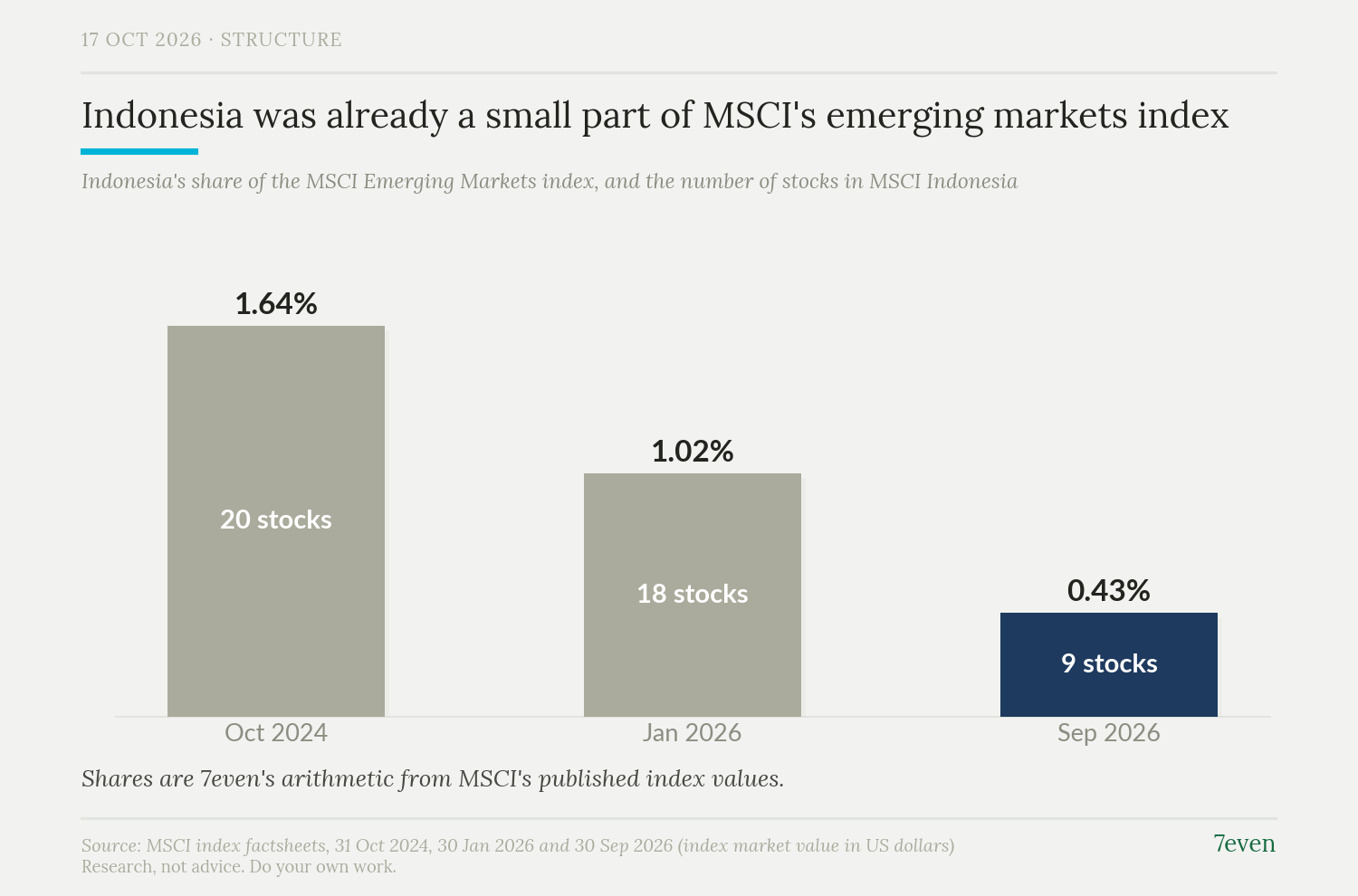
The fall on 16 Oct is the latest step in a long slide. MSCI's own factsheets show it.
| MSCI factsheet date | Stocks in MSCI Indonesia | Indonesia's share of MSCI Emerging Markets | India's share of MSCI Emerging Markets | |---|---|---|---| | 31 Oct 2024 | 20 | 1.64% | 18.84% | | 30 Jan 2026 | 18 | 1.02% | 13.34% | | 30 Sep 2026 | 9 | 0.43% | 10.65% |
Indonesia's share is our arithmetic: the value of MSCI Indonesia divided by the value of MSCI Emerging Markets, both as MSCI prints them in US dollars. Between October 2024 and September 2026 that share fell by about three quarters.
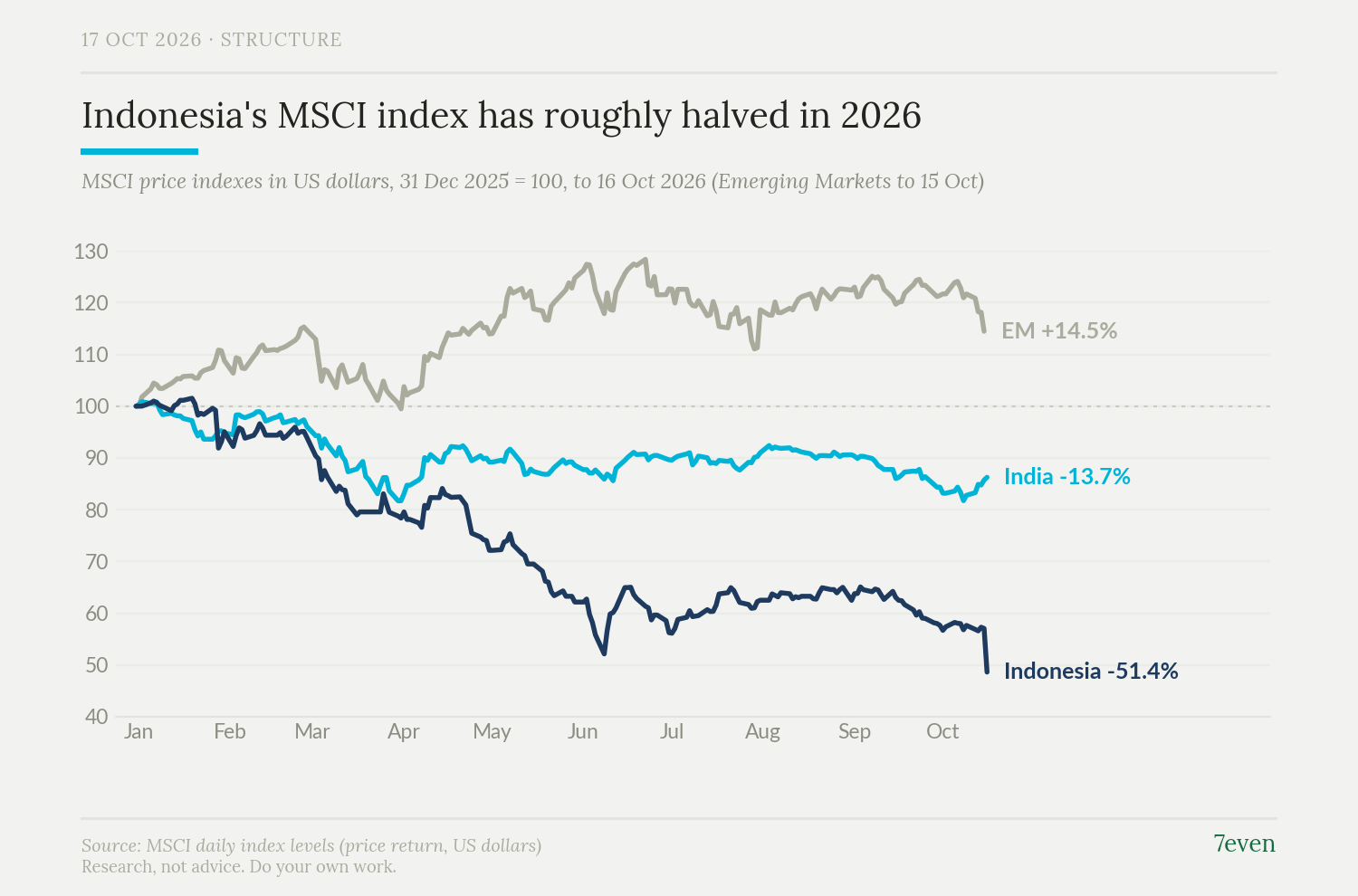
Prices explain only part of the 2026 drop. From 30 Jan to 30 Sep, MSCI Indonesia's price index fell 39.4% in dollars, but the index's total value fell 52.9%. By our estimate, the index's value ended about 22% below where price moves alone would have left it, because stocks and shares left the index. That is the ratio of the two changes, and it lumps together every deletion and float cut. Three of the ten largest members on 30 Jan were no longer in the index on 30 Sep. Over the same months the emerging markets index as a whole grew 10.4% in value, which shrank Indonesia's share further.
16 Oct in numbers
- IDX Composite (all stocks on the Indonesia Stock Exchange, in rupiah): 11.48% below the previous close at 15:49 Jakarta time on 16 Oct, on the exchange's own feed.
- MSCI Indonesia (nine stocks at 30 Sep, in US dollars): down 14.8% on 16 Oct, and down 51.4% since 31 Dec 2025.
- MSCI India (in US dollars): up 0.6% on 16 Oct, and down 13.7% since 31 Dec 2025.
- MSCI Emerging Markets (in US dollars): up 14.5% from 31 Dec 2025 to 15 Oct.
The two Indonesian numbers differ because they measure different things: MSCI's index covered nine large stocks at 30 Sep and is in dollars, while the Composite covers the whole exchange in rupiah.
What it means for India: the arithmetic
MSCI Emerging Markets is weighted by size. Take one country out and every other country's share rises in proportion. At 30 Sep weights, removing Indonesia lifts India from 10.65% of the index to about 10.70%, a gain of about 0.05 of a percentage point.
Put the other way: of every dollar an index fund that copies MSCI Emerging Markets would take out of Indonesia, about 11 cents would go into Indian stocks and about 70 cents into Taiwan, South Korea and China, the three largest countries in the index. For India's gain to reach even 0.1 of a point, Indonesia would need to be about 0.93% of the index at the time of removal, more than double its 30 Sep share, and while the freeze lasts that cannot come from new stocks or more shares.
What that means in dollars. Passive funds, the ones that simply copy an index, would have to drop their Indonesian holdings. Banks have put numbers on it: UBS estimated about $4 billion of passive outflows from Indonesia and JPMorgan $4.8 billion, both as reported by Reuters on 16 Oct. If all of that money followed MSCI Emerging Markets weights, India's share would be roughly $0.4 billion to $0.5 billion. That is our estimate, not a forecast. Reuters does not report which funds the banks' figures cover. Money in funds that copy a global index would send India less, because those funds spread Indonesia's weight across every country they hold; funds that copy only emerging Asia would send India somewhat more. The money also moves only when the change takes effect, after MSCI's decision, and a smaller Indonesia by then means a smaller flow.
India's own share tells a bigger story than this one. It fell from 18.84% to 10.65% between October 2024 and September 2026, which we looked at in July. Indonesia's exit does not change that.
How this could be wrong
- Active managers do not follow index weights. Our arithmetic covers index funds and money run close to the index. A fund manager who sells Indonesia can put more of that money into India than its index share. We have no data on how they will choose.
- The dollar figure rests on the banks' estimates. We have not checked UBS's or JPMorgan's workings, only Reuters' report of them, and India's share depends on which indexes the selling funds copy.
- Weights will be different when the change happens. India's 10.65% moves with its own prices, Indonesia's 0.43% with its prices and any further deletions. The answer comes from MSCI's figures at the time, not from ours.
- MSCI may not go ahead. It has said what would make it reconsider: clear evidence of material improvement found during the consultation.
- The split between prices and deletions is an estimate. It uses two factsheet values and one price index, and cannot say which deletion did what.
The question we are left with
MSCI has set a test without a scorecard. By 30 Apr 2027, what would count as "clear evidence of material improvements", and how far along does the 15% free float roadmap need to be for MSCI to see it?
Sources: MSCI's consultation announcement of 15 Oct 2026; MSCI Indonesia and MSCI Emerging Markets index factsheets (31 Oct 2024, 30 Jan 2026, 30 Sep 2026); MSCI daily index levels; MSCI Global Investable Market Indexes Methodology (January 2020), Section 6; the Indonesia Stock Exchange's index summary for 16 Oct 2026; UBS and JPMorgan estimates as reported by Reuters on 16 Oct 2026.
7even publishes research, not recommendations. Nothing here is investment advice. Always do your own work, and consult a SEBI-registered advisor before acting on anything you read.